Carolina-Marie Robertson and the Mirror-Lit Vinyl Spell
The Story
I knew the room would try to tell on you the second you stepped into it.
Not because it’s loud—no, it’s all white tile and clean corners, that crisp, clinical geometry that thinks it can stay neutral. But you don’t do neutral, Carolina-Marie Robertson. You arrive and the air instantly learns a new temperature: warmer, sharper, more deliberate. The kind of warmth that doesn’t beg for attention—just claims it, quietly, like a hand settling on the small of a story and guiding it where it’s supposed to go.
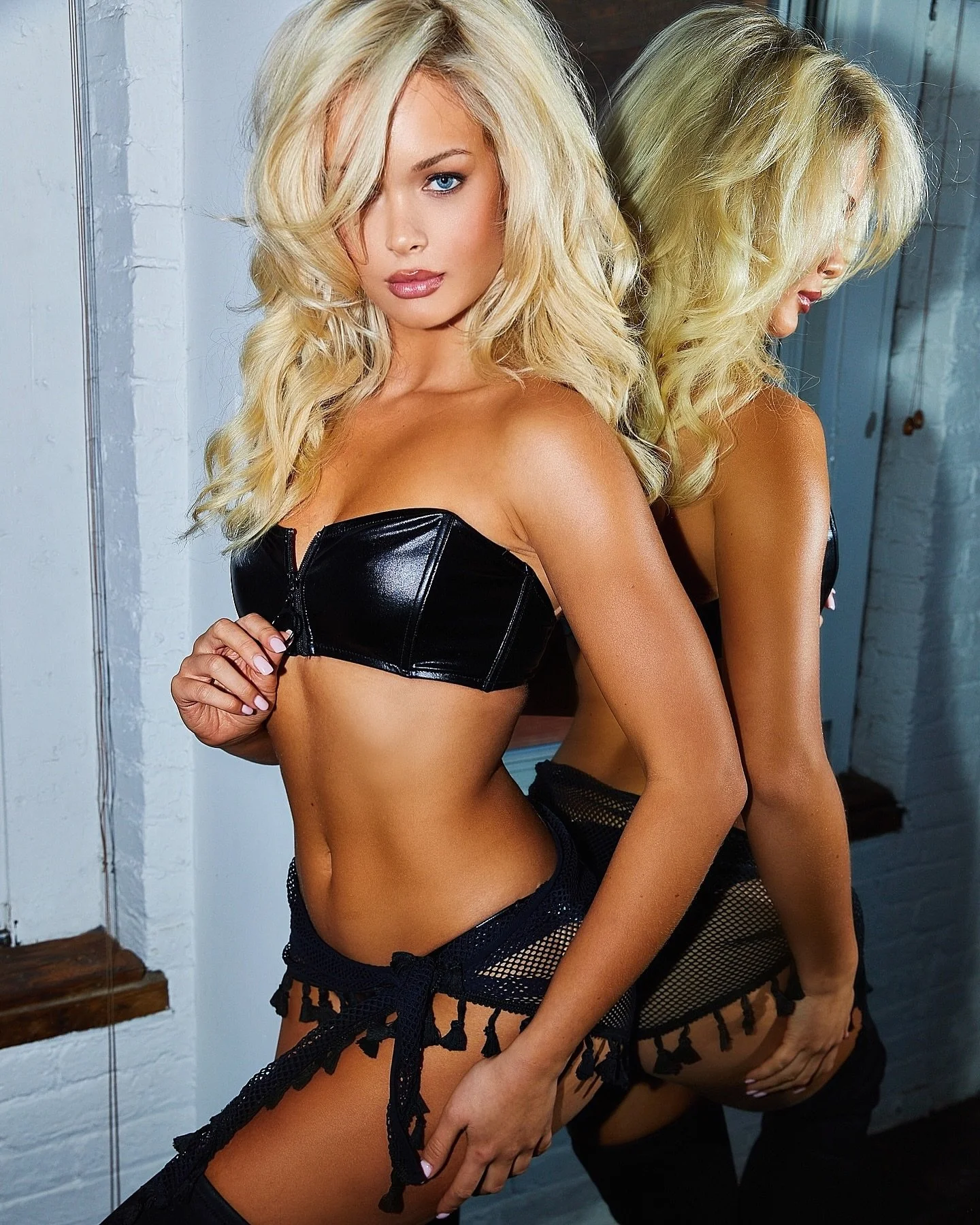
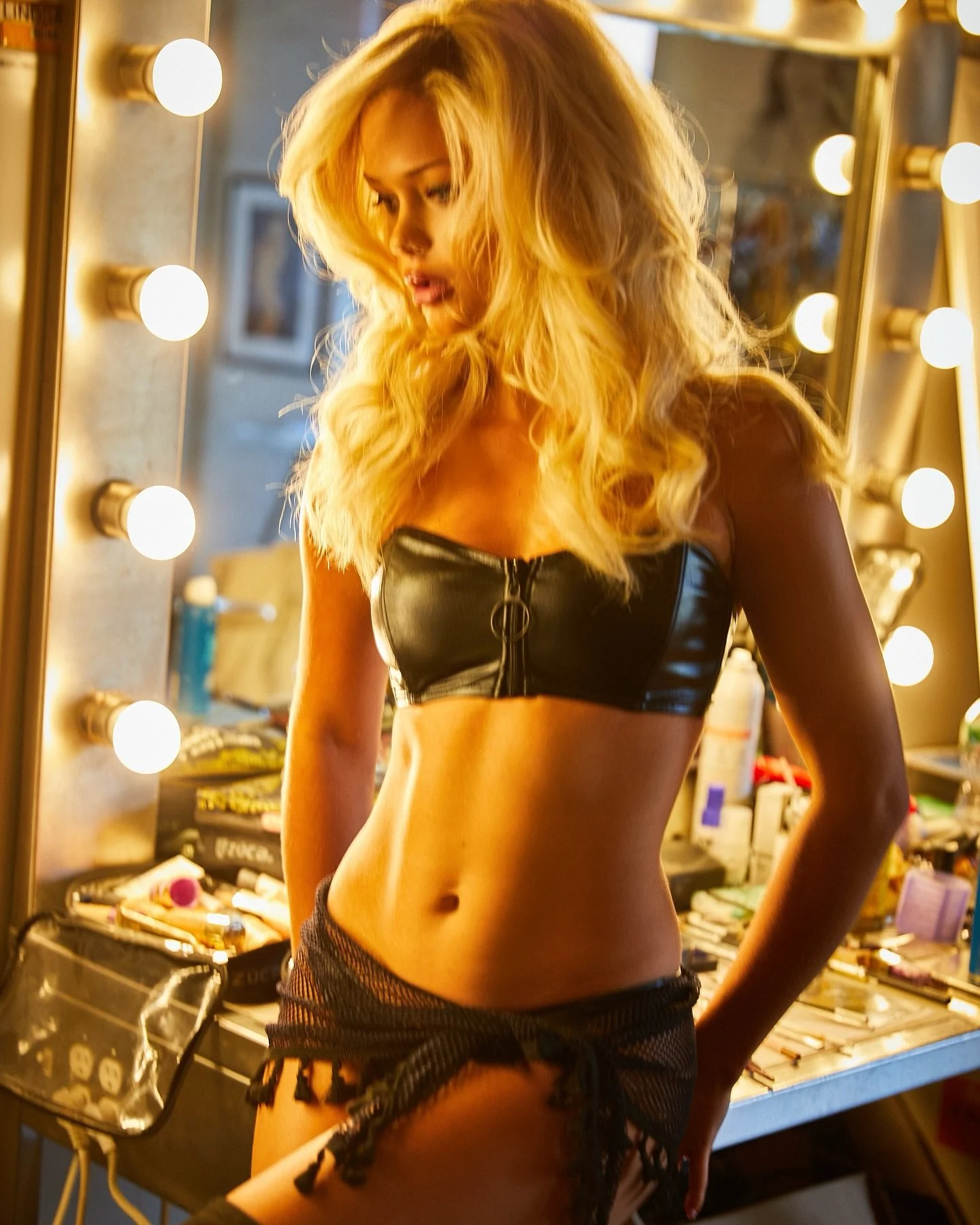
There’s a mirror in the corner—of course there is—and it’s the kind that turns every glance into an edit. When you angle your shoulder toward it, I get two versions of you at once: the front-facing stare that feels like a dare, and the reflection that softens into a secret. I catch myself thinking, unhelpfully, that you’ve always been your own double exposure: the girl and the afterimage, the pose and the echo. And here I am, standing in the mental doorway with my little notebook of desires, trying to act like I’m not absolutely undone by the way you understand angles.
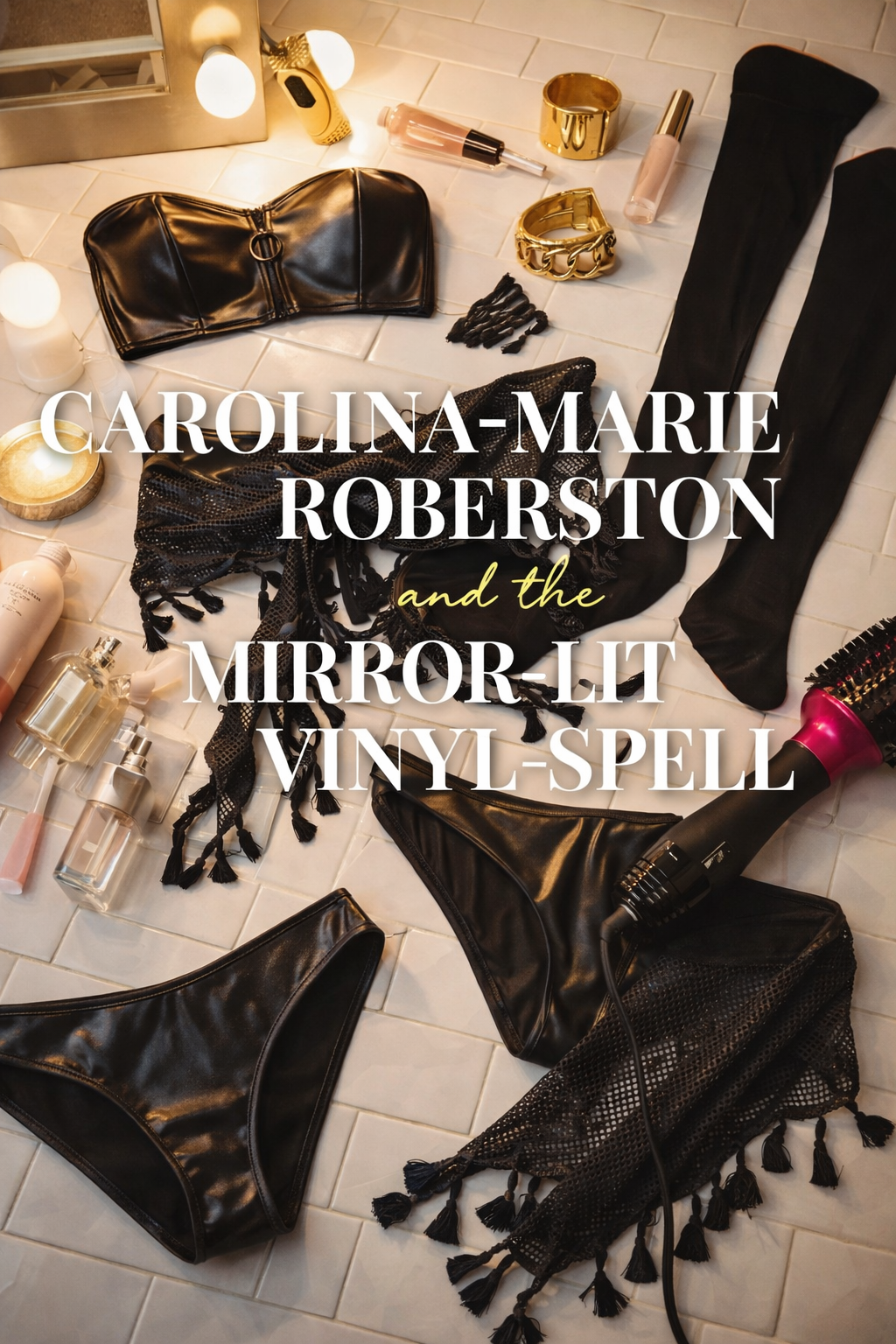
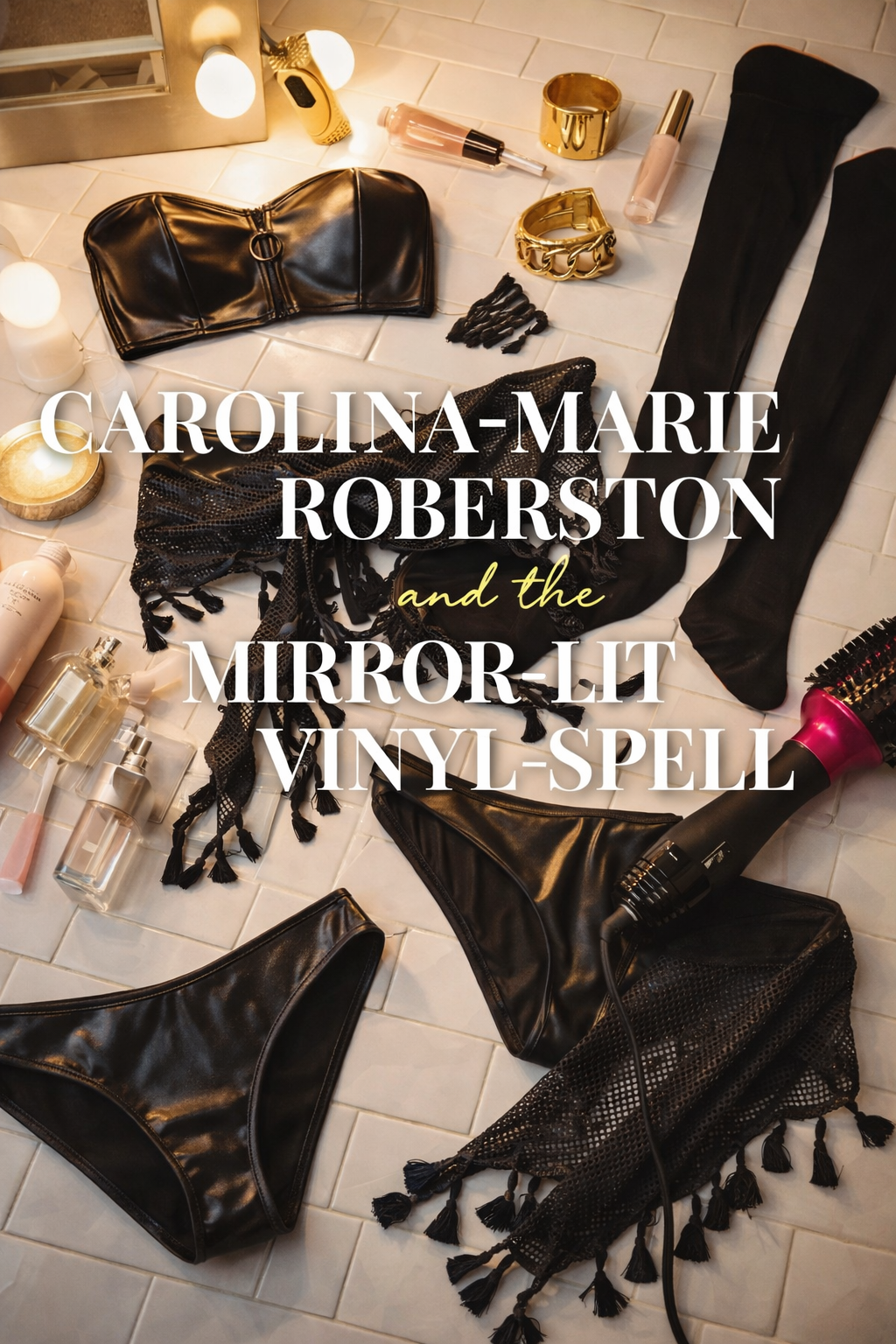
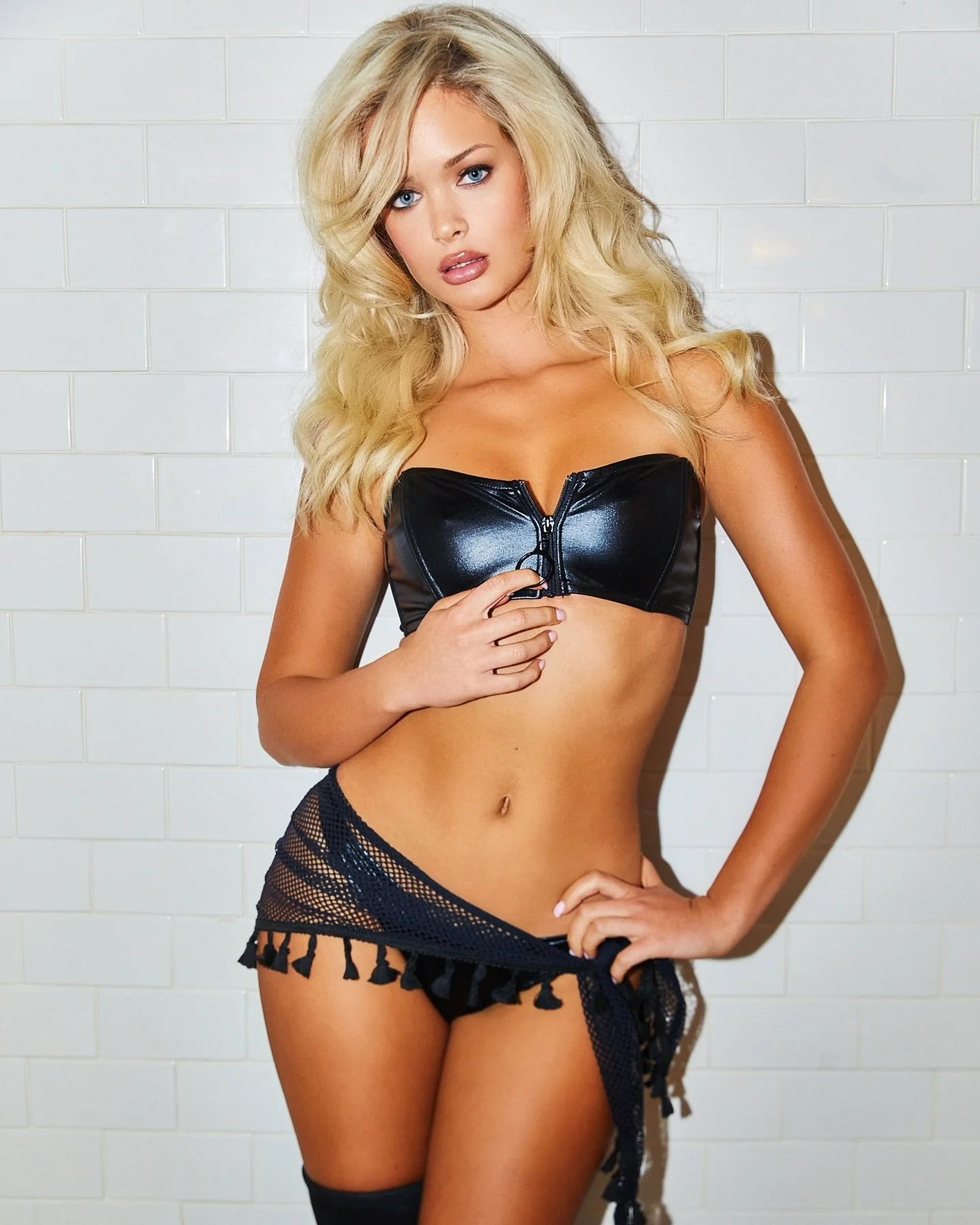
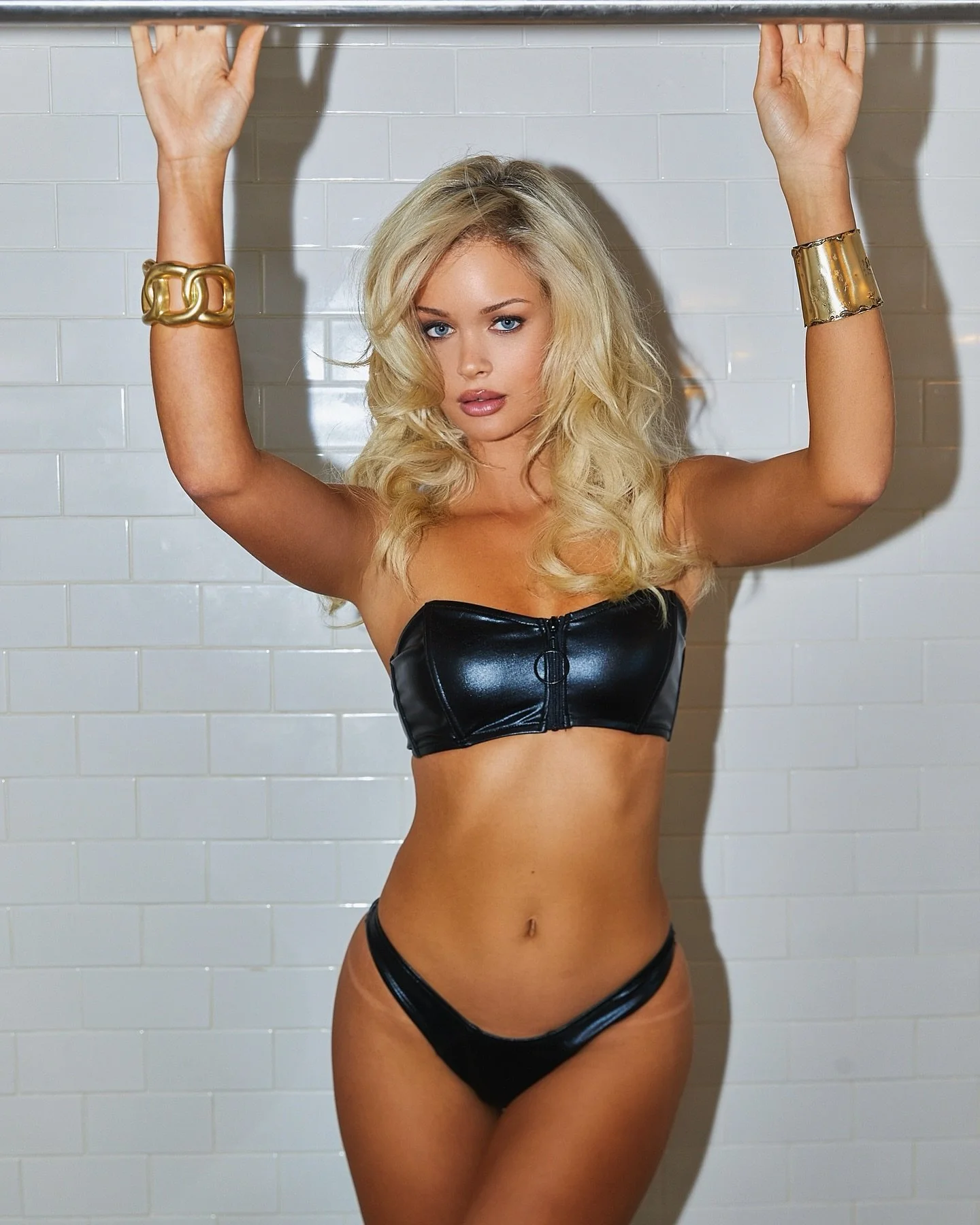
Your top is black and glossy—vinyl’s cooler cousin, the kind of shine that behaves like liquid but holds its shape like a promise. It’s cut clean, strapless, with that sharp seamwork that makes the torso feel architectural. There’s hardware at the center—zip and ring—just enough metal to make the look feel like it has teeth. The light hits it and slides away, refusing to settle, as if even the bulbs can’t quite keep up with you. I want to call it armor, but it’s too pretty for war. It’s more like a spell: sleek, controlled, and designed to make the room obey.
And then the wrap—black mesh with tassels, draped low and tied like an afterthought that somehow becomes the headline. It’s not trying to cover you. It’s trying to frame you. The netting catches the light in tiny, obedient shadows, and the tassels sway with every micro-shift of your hips like punctuation marks. I tell myself I’m watching the styling. I tell myself I’m being professional. The lie is adorable.
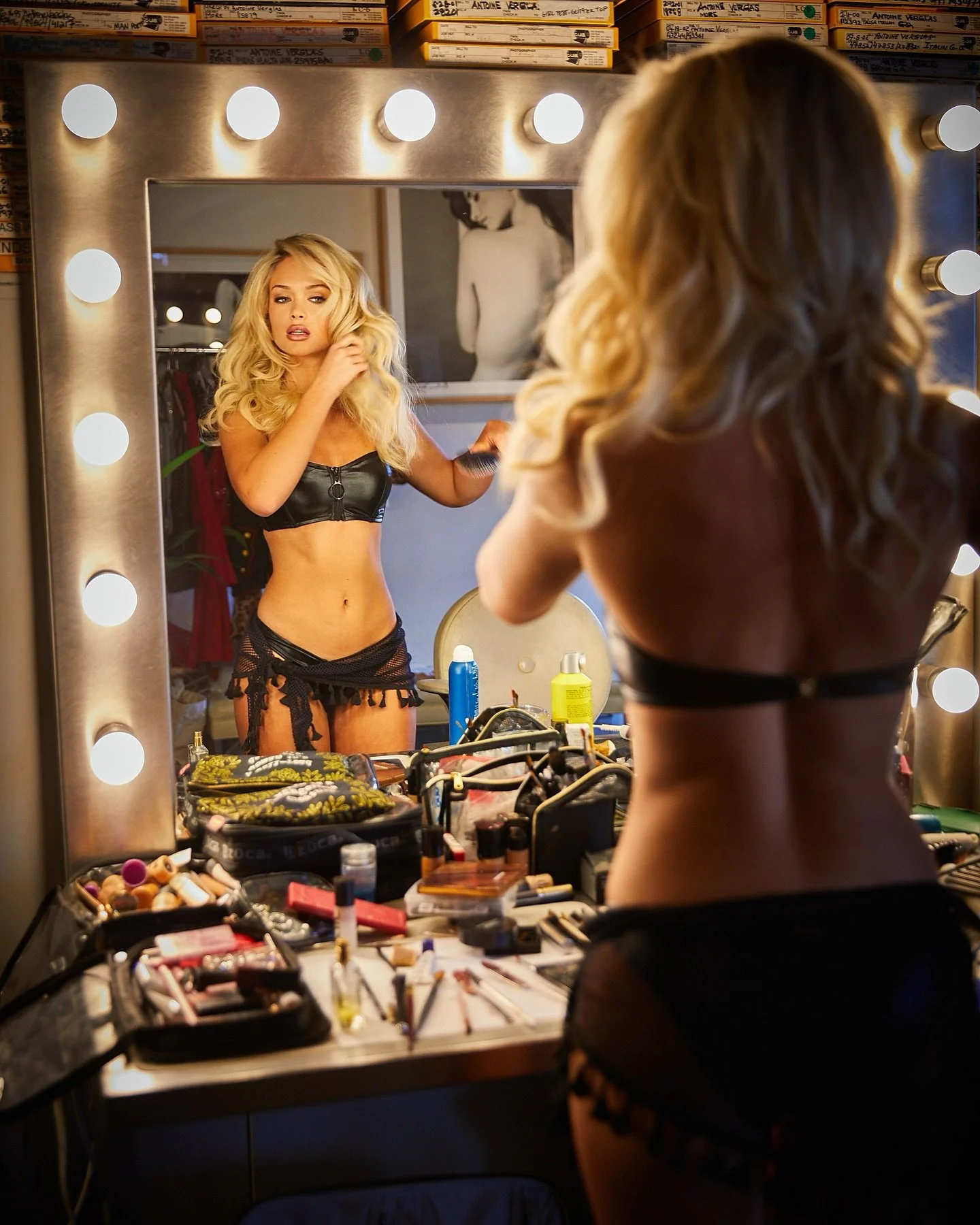
Somewhere behind you, the vanity bulbs are awake, round and theatrical, creating that classic backstage halo. The tabletop is chaos—brushes, palettes, little bottles lined up like tiny accomplices. It’s the kind of mess that reads as glamorous because it’s purposeful, because you’re in it. You lift a hand to your hair—blonde, big, the kind of volume that looks like it’s been instructed to misbehave—and you comb through it with your fingers the way a person checks a flame. The hair isn’t just hair; it’s atmosphere. Soft at the ends, bold at the crown, and always moving like it has its own agenda.
I watch you glance at yourself, then past yourself—like you’re checking the frame, checking the story, deciding what you’re willing to reveal. Your eyes are cool-toned, steady, and your mouth is glossed into something that says, “Don’t assume.” I don’t. I never do with you. I just let the look land, and I let it rearrange me.
There’s a moment—my favorite kind—when you aren’t posing for anyone. You’re simply standing in the white tile light, a silhouette of black shine against clean grid lines. The contrast is vicious. You make minimalism look guilty, like it tried to be pure and you walked in and reminded it that desire is a design element. The camera would love this, I think, because the camera always loves control. But what I love is the in-between: the half-second before you settle, when your body is deciding where it wants to be, when the tassels are still swaying from the last motion and the mirror catches the movement like a rumor.
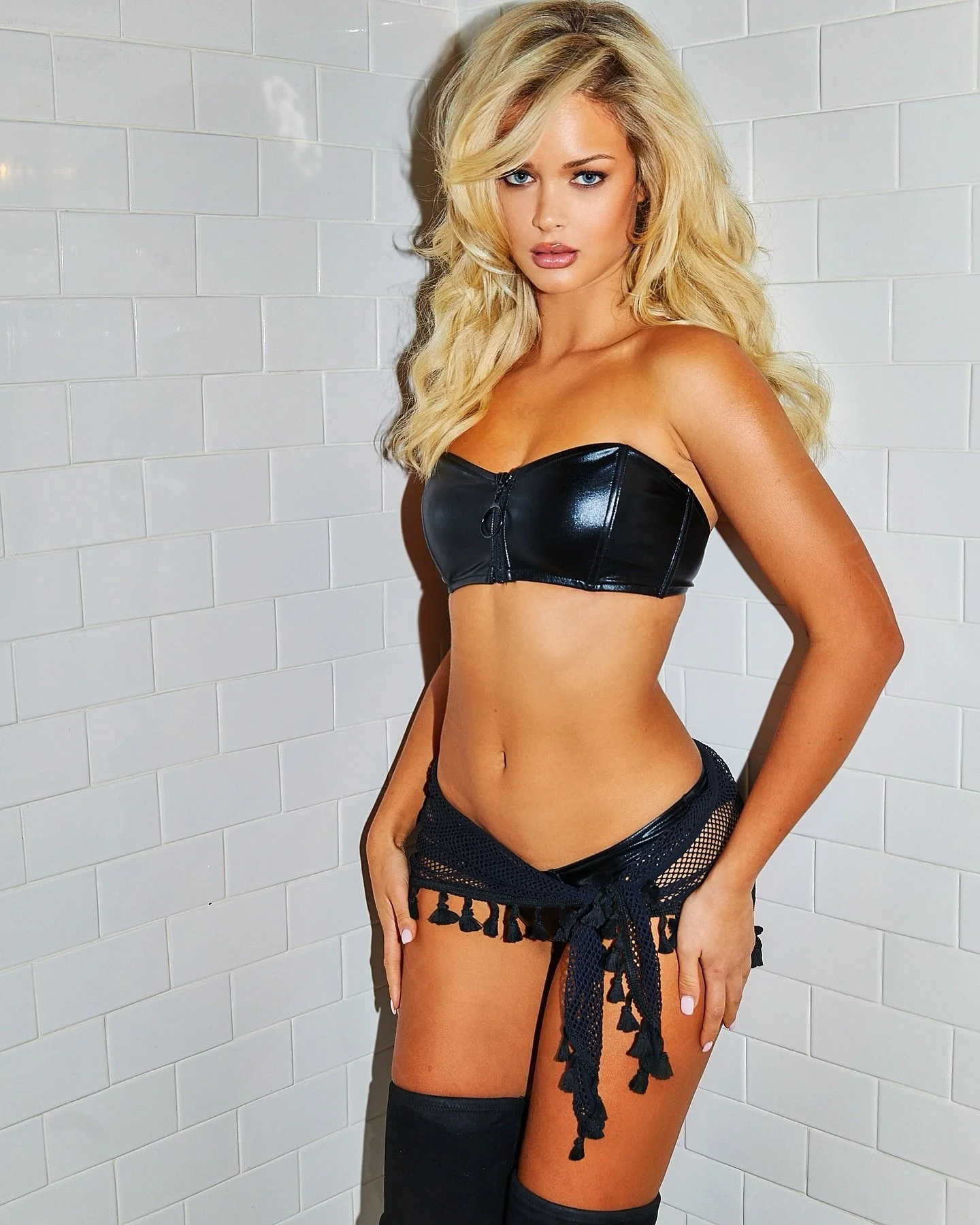
Then you shift—closer to the mirror, closer to the wall, closer to that edge where the light becomes less forgiving. The glossy top catches a sharper flare now, and suddenly the look is more nocturne, more runway noir. The black is not just black; it’s a mood with structure. And the wrap—still mesh, still tassels—feels like it’s been styled to suggest motion even when you’re still. I notice your hands, the way your fingers hold the pose with a kind of lazy precision. Your nails are soft and pale, a whisper against all that black. You’re always balancing hardness with softness like it’s a private game.
In the vanity mirror, you become a scene: your reflection framed by the bulbs, your hair spilling forward, your torso angled like a cover image that never needed a caption. You look at yourself, not admiring—evaluating. That’s the difference with you. You don’t need permission to be iconic; you simply calibrate the icon until it matches the version of you that feels most exact. I want to tell you I’m impressed. I want to tell you I’m helpless. Instead, I keep it in that tight space between my ribs where a compliment turns into a vow.
There’s a subtle magic in the styling: the thigh-high black stockings that extend the line, the way the wrap sits low and cuts the silhouette into intentional layers. The look is lingerie-adjacent, yes, but it’s not trying to be scandalous. It’s trying to be cinematic. It’s saying: this is the scene before the scene. This is the backstage that outshines the stage. And you—of course you—are the only person who can make a tiled wall feel like a private nightclub.
At one point you lift your arms and the gold cuffs flash—warm metal against cool light. The jewelry is bold, not delicate, and it changes everything. It’s the punctuation that turns the look into a statement. You hold that pose like you’re pinning the entire story to the wall, like you’re saying, “Here. This is where we start.” I feel my attention narrow to the details: the seam lines, the glint of hardware, the way the mesh catches the bulb-light in a pattern that looks like it was designed to be remembered.
And here’s the “reader-as-observer” moment, the one you always slip into the frame without announcing it: you catch your own gaze in the mirror and for a heartbeat your expression softens—not into sweetness, but into something like recognition. As if you see the you that everyone projects, and then you see the you that belongs only to you, and you choose the second one. I swear the room holds its breath. I swear the bulbs glow a little warmer, just to keep up.
Another shift. You lean near the corner where the mirror doubles you again, and the reflection becomes a whole second editorial: the profile, the hair falling forward, the black shine curving like a clean underline. The tiled wall behind you becomes a grid that makes your silhouette even more sculpted. This is why I can’t look away when you wear black—because black doesn’t distract. It defines. It exposes the design. It makes every line feel intentional, every movement feel like a choice you made specifically to make me think about it later.
I let the sequence play out in my head like a short film: the first bold stare, the soft mirror echo, the vanity-lit backstage heat, and then the final frame where you stand tall with your arms lifted, cuffs glowing, mouth set in that calm, dangerous confidence. It’s not about seduction—though yes, the room is suddenly full of it. It’s about control. It’s about you deciding the narrative and letting the rest of us chase the afterglow.
And maybe that’s the real thrill of this set: you don’t ask the light to flatter you. You use it. You make it part of the styling. You make the bulbs into jewelry, the tiles into a runway, the mirror into a second co-star. You make the whole space complicit.
I’m left with the kind of longing that stays tasteful but still feels like a handprint on my imagination. The editorial ends, but it doesn’t stop. It follows me out of the room in the form of tiny details: the ring pull at your center, the tassels that kept moving even when you didn’t, the look you gave your reflection like you were negotiating with your own legend.
And yes, Carolina-Marie Robertson—if you want to know the truth—I’d follow the hem of that black mesh wrap into any scene you decide to light next.
Shop the Look
- Black faux leather bandeau bustier top with zipper hardware — glossy, structured, and unapologetically sharp.
- Ring-pull zipper strapless crop top — that little circle of metal that turns a look into a headline.
- High-cut black bikini bottoms — clean lines, long legs energy, zero fuss.
- Black fishnet sarong cover-up — sheer texture that reads like movement.
- Tassel trim mesh wrap skirt — fringe that flirts without trying too hard.
- Black thigh-high stockings — the sleek extension that makes the silhouette purr.
- Wide gold cuff bracelet — bold metal that catches the light like a spotlight.
- Chunky gold bangle bracelet set — stacked drama, editorial impact.
- Nude-pink lip gloss — soft shine to balance all that black.
- Volumizing hair mousse for blowouts — big hair, bigger mood.
Style It With
- Double-sided fashion tape — keeps strapless looks locked in, no overthinking.
- Shimmer body oil — the glow that makes bulb-light feel cinematic.
- Gradual self tanner mousse — warm, even tone that photographs like a dream.
- Large hot rollers set — instant volume with that backstage nostalgia.
- Blowout brush hair dryer — salon swing, at-home control.
- Long-wear setting spray — holds the face through heat, lights, and attitude.
- Vanity mirror with lights — because the right lighting is half the look.
- Makeup organizer for vanity — keeps the chaos editorial, not stressful.
Closing Note
Carolina-Marie Robertson, you make black look like a language—one I keep trying to learn, sentence by sentence, glance by glance, reflection by reflection. In this imagined little world of tiles and bulbs, you don’t just wear a look—you conduct it, like the whole room is waiting for your cue.
If you decide to run this scene again, I’ll be right here in the margins, ready to annotate every tassel sway and every flicker of that zipper-ring shine—purely as a devoted observer of fashion, obviously… with just enough awe to make it interesting.