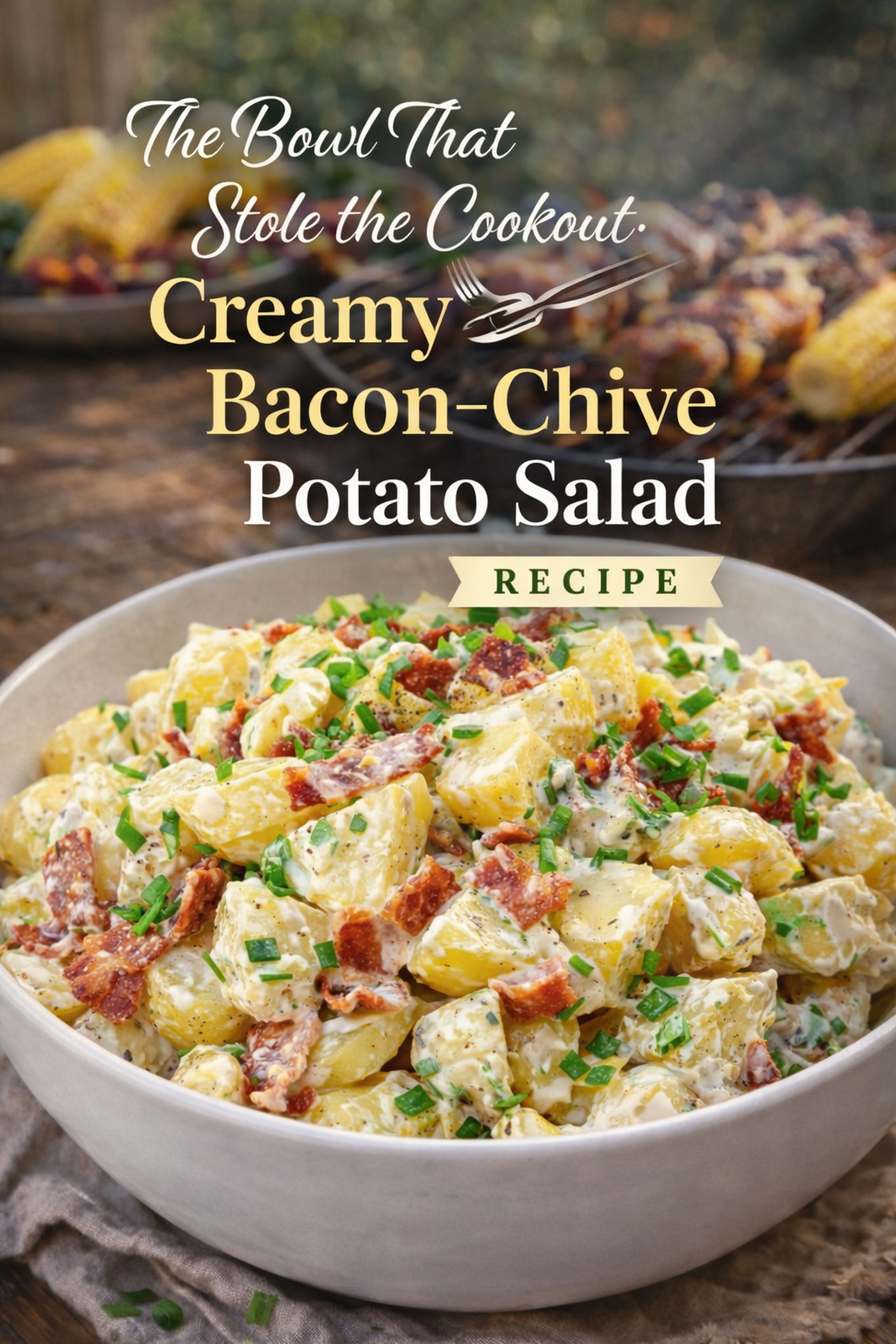
The Bowl That Stole the Cookout: Creamy Bacon-Chive Potato Salad Recipe
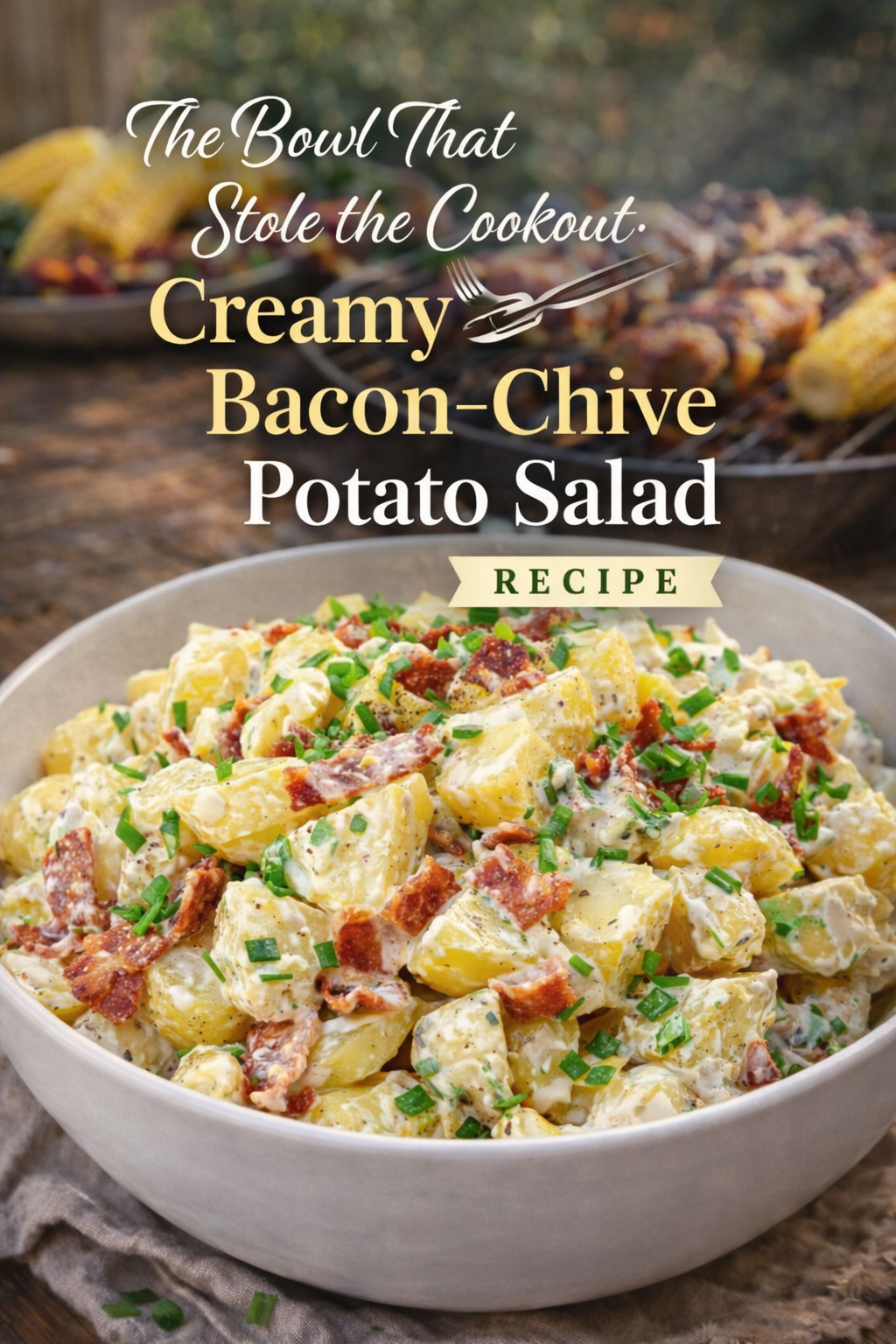
Late afternoon light hits the table like a warm spotlight, turning every edge of the scene a little more golden than it has any right to be. The wood beneath the bowl looks weathered in the best way—scuffed, sun-kissed, lived-in—like it has hosted a hundred small celebrations and still has room for one more. In the foreground, a wide, pale bowl holds a potato salad that refuses to play background music. It’s bold without being loud, creamy without being heavy, and scattered with green chives like a confetti toss that landed exactly where it should.
The potatoes are cut into generous chunks—tender but not collapsing—each piece glossed in a thick, pepper-flecked dressing that clings rather than slides. The color is the soft ivory of something made slowly and with intention, the kind of creaminess that suggests the right balance between richness and lift. You can almost taste the snap of black pepper before the fork even rises. And then there’s the bacon: crisp shards with that deep mahogany edge, broken into irregular ribbons so every bite gets a different kind of crunch. The bacon doesn’t just sit on top—it punctuates the whole bowl, a smoky, salty spark in the middle of something cool and comforting.
Chives bring the brightness, that fresh onion-green note that cuts through the creamy base like sunlight through a porch screen. They’re chopped small, scattered generously, and the effect is more than garnish—it’s a promise that the salad won’t feel flat. It’s the sort of detail that makes a familiar classic feel newly alive.
Behind it all, the day keeps going. A grill sits open, heat shimmering in the imagination even if you can’t see it, and something caramelized rests on the grate—dark, glossy, and char-kissed. Nearby, corn on the cob glows like summer itself, yellow kernels catching the light as if they’ve already been buttered. Off to the side, a pan of vegetables—reds and greens—looks like the supporting cast that’s secretly excellent on its own. The whole tableau feels like the exact moment a cookout becomes a memory: not the beginning, not the end, but the middle—when everyone’s hungry, laughing, and circling back for “just a little more.”
This is the kind of dish that gets people standing closer to the table than they meant to. It’s the bowl that disappears first, the one someone’s quietly scraping from the edges with a serving spoon when they think nobody’s watching. It’s comfort food with clean edges—homey, yes, but finished. The dressing looks like it was built with care, the kind that starts in a deep mixing bowl set that won’t skate across the counter and ends with a final shower of herbs you didn’t measure because you didn’t need to.
There’s something about potato salad that invites opinions, the way barbecue invites debate. Some want it sweet. Some want it sharp. Some swear by mustard; others treat mustard like a personal insult. But the version in front of you feels like the peace treaty. It’s classic enough to satisfy the purists, yet upgraded in the ways that matter—texture, balance, and that smoky edge that bacon brings when it’s cooked properly on a crispy bacon-friendly sheet pan or sizzled until just right in a cast iron skillet that holds heat like a secret.
The potatoes look like they were chosen for their bite, not their beauty—small golds or baby reds that hold their shape and soak up flavor without turning to mush. That’s the quiet genius of the best potato salad: it’s not hard, but it’s precise. It’s the difference between “fine” and “can you text me the recipe.” A dish like this rewards the cook who pays attention to small moments—the salt in the water, the steam drying the potatoes, the timing of the dressing while the potatoes are still warm enough to drink it in.
Even the setting matters. This bowl belongs outdoors. It belongs on a towel-soft linen napkin, on a table close enough to the grill that the air smells faintly of smoke and caramelization. It belongs beside corn that’s been turned and turned until the kernels darken at the edges, beside a platter waiting for a final brush of sauce, beside a stack of plates and the kind of serving spoon set that makes scooping clean and easy. It belongs in the middle of a gathering, where conversation is layered over the clink of ice in glasses and someone in the background says, “Did you try the potato salad yet?”
The best part is how effortless it looks once it’s done—how the creamy dressing nestles into every corner, how the bacon keeps its crunch, how the chives brighten every bite. It gives the impression that it’s always been part of summer, like it’s been waiting for you to remember it. And when it lands on a plate next to something hot off the grill, it does what potato salad is supposed to do: cool the heat, round out the smoke, and make the whole meal feel complete.
Some dishes are loud. This one is confident. It doesn’t beg for attention—it earns it, one forkful at a time, until the bowl is lighter than it was a minute ago and someone is already asking if there’s more in the fridge.
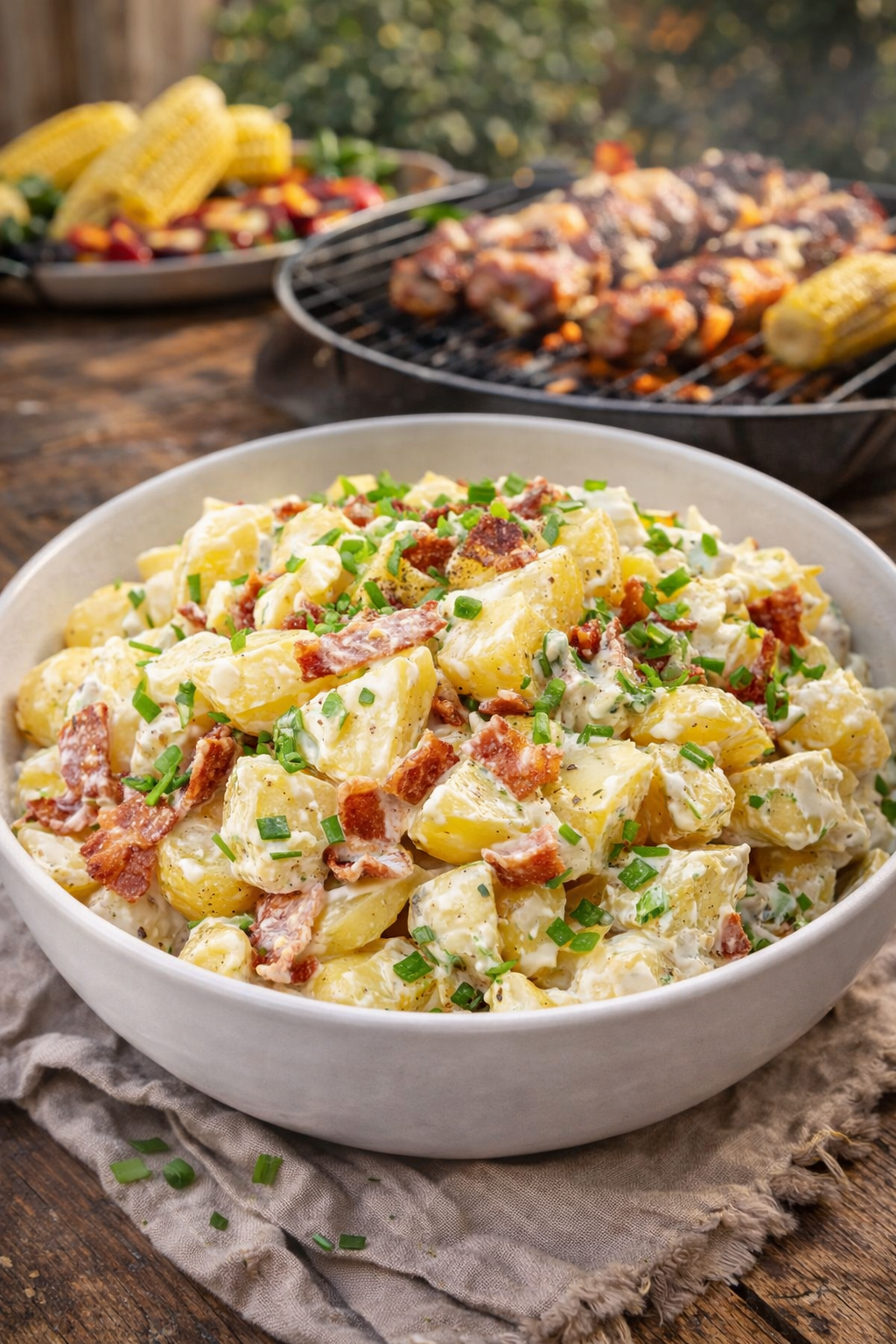
Creamy Bacon-Chive Potato Salad
A classic, cookout-ready potato salad with tender potatoes, a tangy-creamy dressing, crisp bacon, and a fresh finish of chives.
Ingredients
- 2 1/2 lb baby gold potatoes (or small red potatoes), halved or quartered
- 1 1/4 tsp kosher salt, plus more for the cooking water
- 1/2 tsp black pepper (plus more to taste)
- 3/4 cup mayonnaise
- 1/4 cup sour cream (or plain Greek yogurt)
- 1 1/2 tbsp Dijon mustard
- 1 tbsp apple cider vinegar (or pickle brine)
- 1/2 tsp garlic powder (optional)
- 6 slices bacon, cooked crisp and crumbled
- 1/4 cup finely chopped chives
- Optional: 1–2 tbsp finely diced dill pickles or relish
Method / Instructions
- Cook the potatoes: Place potatoes in a pot, cover with cold water, add a generous pinch of salt. Bring to a simmer and cook until fork-tender (10–15 minutes, depending on size). Drain well.
- Dry and season: Let potatoes steam-dry in the colander for 5 minutes, then transfer to a bowl and season with 1/2 tsp salt and the pepper.
- Make the dressing: In a small bowl, whisk mayonnaise, sour cream, Dijon, vinegar (or pickle brine), remaining salt, and garlic powder if using.
- Combine: While potatoes are still slightly warm, fold in the dressing until coated. Add most of the bacon and chives (reserve a little for the top). Add pickles/relish if using.
- Chill: Cover and refrigerate at least 1 hour (best 3–4 hours) for flavor to develop.
- Finish: Top with reserved bacon and chives, taste, and adjust salt/pepper before serving.
The In-Depth Step-By-Step Guide
Choose the right potato—and cut for texture
If the goal is a potato salad that looks like the bowl in the image—chunky, glossy, and intact—start with waxy potatoes. Baby golds and small reds are ideal because they hold their shape and stay creamy inside. Cut them into even bite-size pieces so they cook at the same pace; uneven chunks guarantee some pieces go mushy while others stay underdone. A sharp, comfortable chef’s knife that glides through thin skins cleanly makes this step faster and safer.Salt the water like it matters—because it does
Potatoes are mild, which means you’re either seasoning them along the way or trying to fix it at the end. Add enough salt to the cooking water that it tastes pleasantly salty. This is the first layer of flavor, and it’s non-negotiable if you want a salad that tastes “built,” not “dressed.”Start in cold water for even cooking
Dropping potatoes into boiling water cooks the outside too quickly and risks ragged edges. Starting in cold water lets the potatoes warm gradually, which helps them cook evenly and stay intact. Bring the pot up to a gentle simmer rather than a rolling boil—aggressive boiling knocks the pieces around and breaks them, turning your salad into a creamy mash before you ever add dressing. A sturdy large stock pot that holds heat steadily helps maintain that controlled simmer.Nail the doneness: fork-tender, not collapsing
Check early and often. You want a fork to slide in with little resistance, but the potato should still hold its corners. Overcooked potatoes absorb too much dressing and lose their distinct bite; undercooked potatoes taste chalky and resist the creamy coating. When they’re done, drain immediately.The steam-dry trick that changes everything
Drain well, then let the potatoes sit in the colander for 5 minutes so steam can evaporate excess moisture. Wet potatoes dilute dressing and make the salad watery. Steam-drying also helps the dressing cling rather than slide off. If you want to be extra precise, spread the potatoes on a rimmed baking sheet for quick drying before tossing.Dress them while they’re warm—this is the secret
The bowl in the image looks like every potato has been seasoned from the inside out. That happens when you add dressing while the potatoes are still slightly warm. Warm potatoes soak up flavor; cold potatoes repel it. The goal is not “hot,” but “warm enough to welcome the dressing.”Build the dressing for balance: creamy, tangy, peppery
A great potato salad dressing tastes slightly sharper than you think it should on its own—because the potatoes will mellow it. Mayo gives body. Sour cream (or Greek yogurt) gives brightness and a little tang. Dijon adds depth and gentle heat. Vinegar (or pickle brine) lifts everything and keeps the salad from feeling heavy. Whisk it smooth in a small bowl set that makes mixing clean and quick, then taste. If it feels flat, add a touch more vinegar. If it feels too sharp, add a spoonful more mayo.Season in layers, then finish with pepper like the photo
Salt and pepper shouldn’t be an afterthought. Lightly season the warm potatoes before the dressing goes in, then taste again after combining. The speckled pepper look in the image isn’t just style—it’s flavor. Freshly cracked pepper gives a brighter bite than pre-ground. A reliable pepper grinder that actually cracks evenly is a small upgrade that shows up in every forkful.Cook bacon for crunch that stays crunchy
The bacon in the bowl is crisp, broken into rustic pieces, and it doesn’t look soggy. To keep it that way, cook it until properly crisp, then drain well. Baking is the easiest route for consistent results: lay strips on a rack over a sheet pan so fat drips away. That’s why a bacon rack for sheet pans earns its keep. Let the bacon cool fully before crumbling; warm bacon releases steam and softens faster.Add herbs twice—inside for flavor, on top for beauty
Chives bring that clean, green lift that makes the whole salad feel fresh. Mix most of them in, then reserve a handful for the top. This gives you flavor throughout and that bright, just-finished look you see in the image. If you want a slightly more assertive herbal note, a little dill works beautifully—just keep it restrained so the chives stay the star.Fold, don’t stir—protect the potatoes
Aggressive mixing smashes the potatoes and turns the salad gluey. Use a gentle folding motion with a flexible silicone spatula that won’t tear the potatoes. The dressing should coat every piece, but you still want distinct chunks, not a mashed base.Chill for cohesion, then re-season before serving
Potato salad always tastes better after it rests. One hour is the minimum; three to four hours is where it becomes cohesive and rounded. The potatoes drink in the dressing, and the tang settles into something smoother. Before serving, taste again. Cold food mutes salt, so you may need a final pinch. Add a fresh crack of pepper and the reserved chives and bacon right before it hits the table.Variations that keep the soul intact
- More tang: Swap some vinegar for pickle brine, or stir in finely diced dill pickles.
- Extra richness: Add one finely minced hard-boiled egg or a spoonful of bacon fat to the dressing (a little goes a long way).
- Lighter feel: Use Greek yogurt for half the mayo and add lemon juice instead of vinegar.
- Subtle heat: A pinch of cayenne or smoked paprika adds warmth without turning it spicy.
- Onion note: If chives aren’t available, finely sliced green onion works—use the green parts for a similar freshness.
- Troubleshooting like a pro
- Too watery: Potatoes weren’t steam-dried enough, or the salad sat too long at warm temps. Fix by stirring in a spoonful of mayo and chilling; next time, dry potatoes longer.
- Too thick: Add a teaspoon at a time of vinegar, pickle brine, or even a splash of milk to loosen.
- Bland: It needs salt and acid. Add a pinch of salt, then a small splash of vinegar, tasting as you go.
- Mushy: Overcooked potatoes or overmixing. Next time, simmer gently and fold carefully.
- Bacon went soft: Add part of the bacon at the end and reserve a heavy sprinkle for the top right before serving.
- Serving notes that match the scene
This salad shines next to anything charred and smoky—grilled chicken, ribs, burgers, corn, blistered vegetables. Serve it cold or slightly cool, not ice-cold, so the flavors open up. If you’re transporting it, a snug lidded serving bowl that travels cleanly keeps it tidy and helps it hold temperature.
When everything is done right, you get exactly what the image promises: chunky potatoes wrapped in a creamy, peppery dressing, crisp bacon in every scoop, and chives that keep it bright. It doesn’t just sit on the table—it anchors the whole spread, the kind of side that becomes the reason people remember the day.