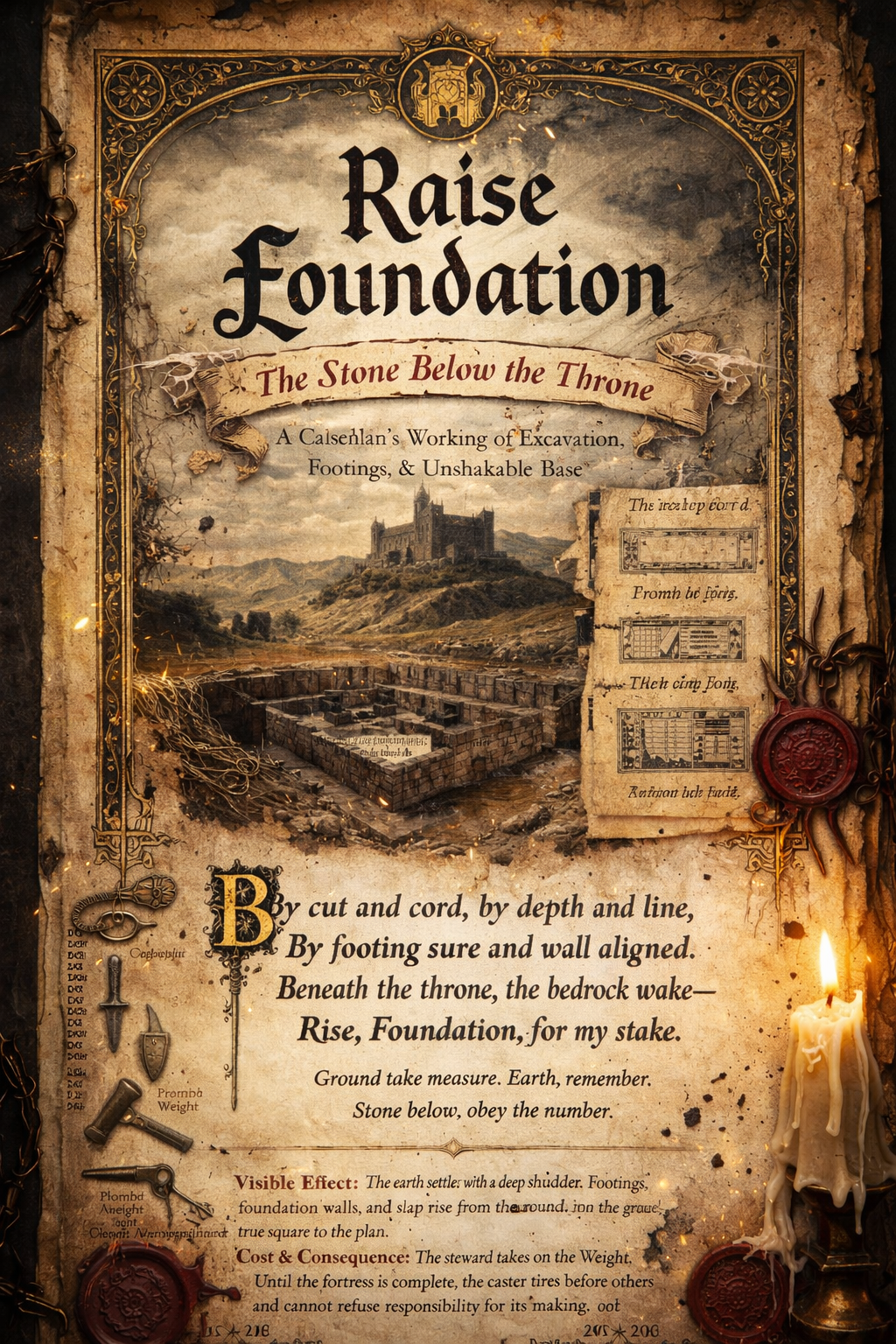
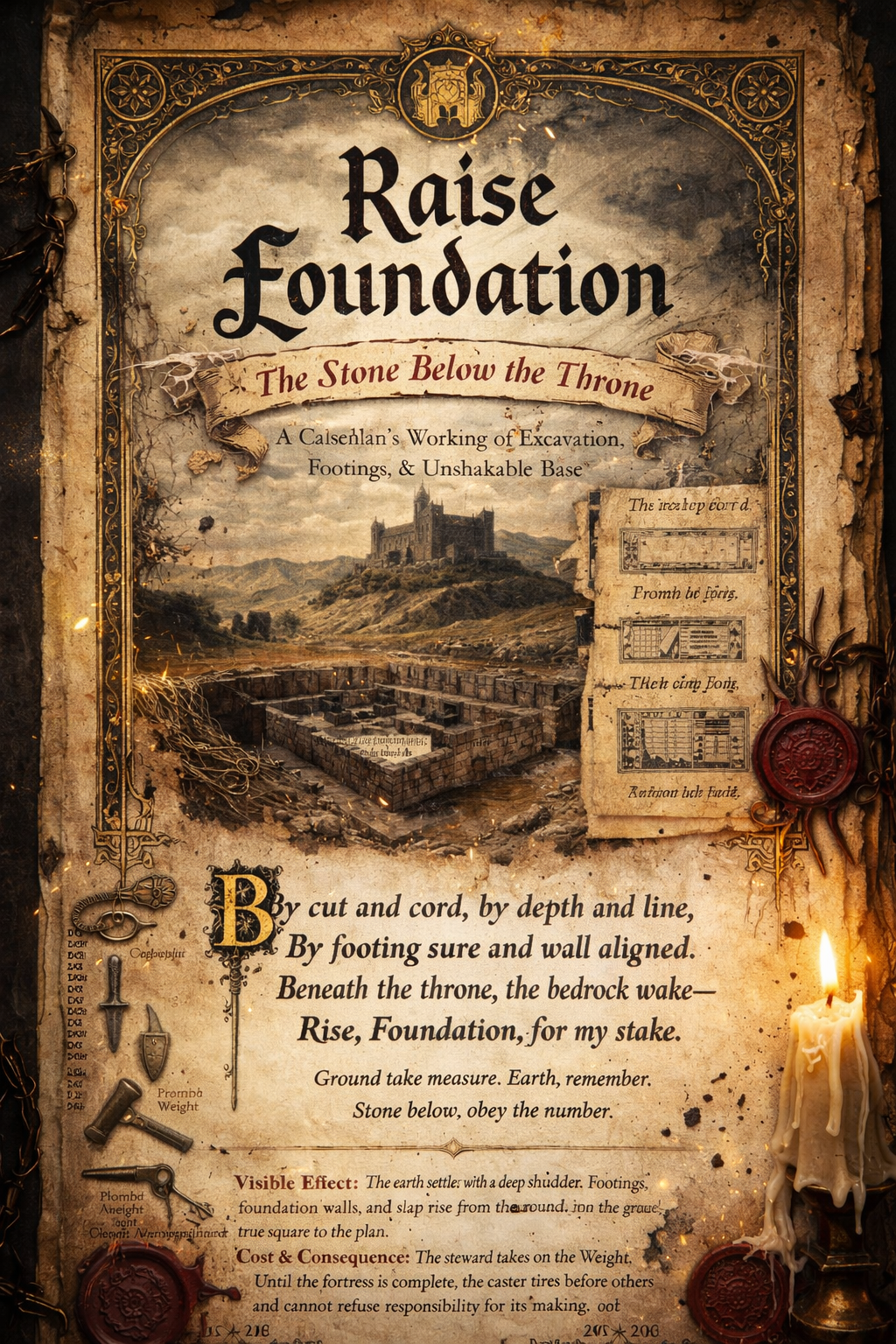
Raise Foundation: The Stone Below the Throne
Opening Lore
Among the oldest works of the Black Grimoire Castle tradition, Raise Foundation is spoken of with a reverence usually reserved for coronations, funerals, and blood sworn oaths. It is not the spell that crowns a tower or seals a gate. It is the spell that decides whether any tower may stand at all. Where lesser builders dream of parapets, banners, and moonlit halls, the old masters begin in silence beneath the mud, beneath the frost, beneath the reach of root and rain. They begin where no guest will ever look, yet where every wall must place its trust.
Raise Foundation is the feared labor of making the earth consent. It is the conjuration of trenches cut true, of deep footings laid in grave order, of foundation walls lifted from the dark like the ribs of a buried giant, and of the great slab poured as a single promise beneath the future keep. Without it, a fortress becomes only a boast waiting to crack. With it, the castle enters a covenant with weight, season, and time.
The old chronicles say the spell first emerged in an age when whole citadels vanished into marshes, their proud halls swallowed because their makers loved the look of stone more than the law of ground. Out of that ruin came the first Foundation Scribes, architects of the underrealm who mapped frost lines, studied runoff, marked bearing soil, and taught that no wall should rise before the land had been tested, drained, compacted, measured, and bound. They were not adored by kings. They delayed beauty. They demanded patience. They dug long before they built. Yet their castles still stand when brighter kingdoms have gone to rubble.
To invoke Raise Foundation is to accept a harsh truth of the fortress path. Splendor begins in excavation. Majesty begins in mud. The throne room, the chapel vault, the black stair, the battlement walk, all of it is decided down in the trench where water is turned away, steel is placed in order, forms are braced, and the first geometry of permanence is called into being. This is why the spell matters. It does not create the visible glory of the castle. It creates the right of that glory to remain.
Arcane Theory
Raise Foundation is governed by one of the deepest laws in castle sorcery: stone does not trust imagination. It trusts pressure, depth, drainage, and proportion. The fictional force behind this spell is known in the oldest manuscripts as the Weight Memory of the Earth, a dark and patient intelligence said to remember every burden ever placed upon it. According to the castle masters, the ground listens when cut, answers when compacted, and rebels when burdened without ceremony. Raise Foundation succeeds because it does not command the earth as a tyrant. It negotiates with it like an ancient and dangerous sovereign.
The spell responds first to excavation. Earth that has not been opened cannot be read. The trench is not merely a cut in soil but a line of revelation where weak fill, hidden water, loose strata, and buried instability show their nature. Once exposed, the land must be shaped and corrected. This is where the force of the spell begins to gather. Soil is removed, subgrade is leveled, bearing zones are tested, and all false softness is banished. Only then can the lower geometry of the fortress be drawn.
Footings are the first true bone of the working. In arcane terms, they are the spreading hands of the castle, reaching outward beneath the walls so weight does not strike the ground like a spear but settles across it like a sentence of law. Wider footings calm the land. Deeper footings escape frost and treachery. Reinforcing bars are thought of as memory rods, holding the intention of alignment and continuity even while concrete is still fluid and formless. The walls that rise from these footings are not decorative divisions. They are the first vertical oath, lifting the fortress from damp soil and separating the clean order of the keep from the restless underworld below.
The slab is the seal of the spell. It is the broad plane in which voids are banished, loads are distributed, and the future life of the castle gains a floor that neither drifts nor surrenders. In the manuscripts, the slab is called the Sleeping Shield, because it lies still while defending everything above it from settlement, cracking, and seepage. Moisture barriers, drainage channels, gravel beds, and control joints are all symbolic in this fiction as forms of warding. They tell water where it may travel and where it may not remain.
What makes Raise Foundation rare is not spectacle but discipline. It requires measure without vanity, patience without applause, and exactness in mud where no court poet will ever sing. It is costly because it consumes labor, stone, steel, and time before any visible magnificence is won. It is dangerous because a single error below the line of sight may blossom into ruin years later when walls lean, floors split, and towers mourn their own weight. This is why the masters say a castle is not tested when its banners fly. It is tested in the unseen pact beneath them.
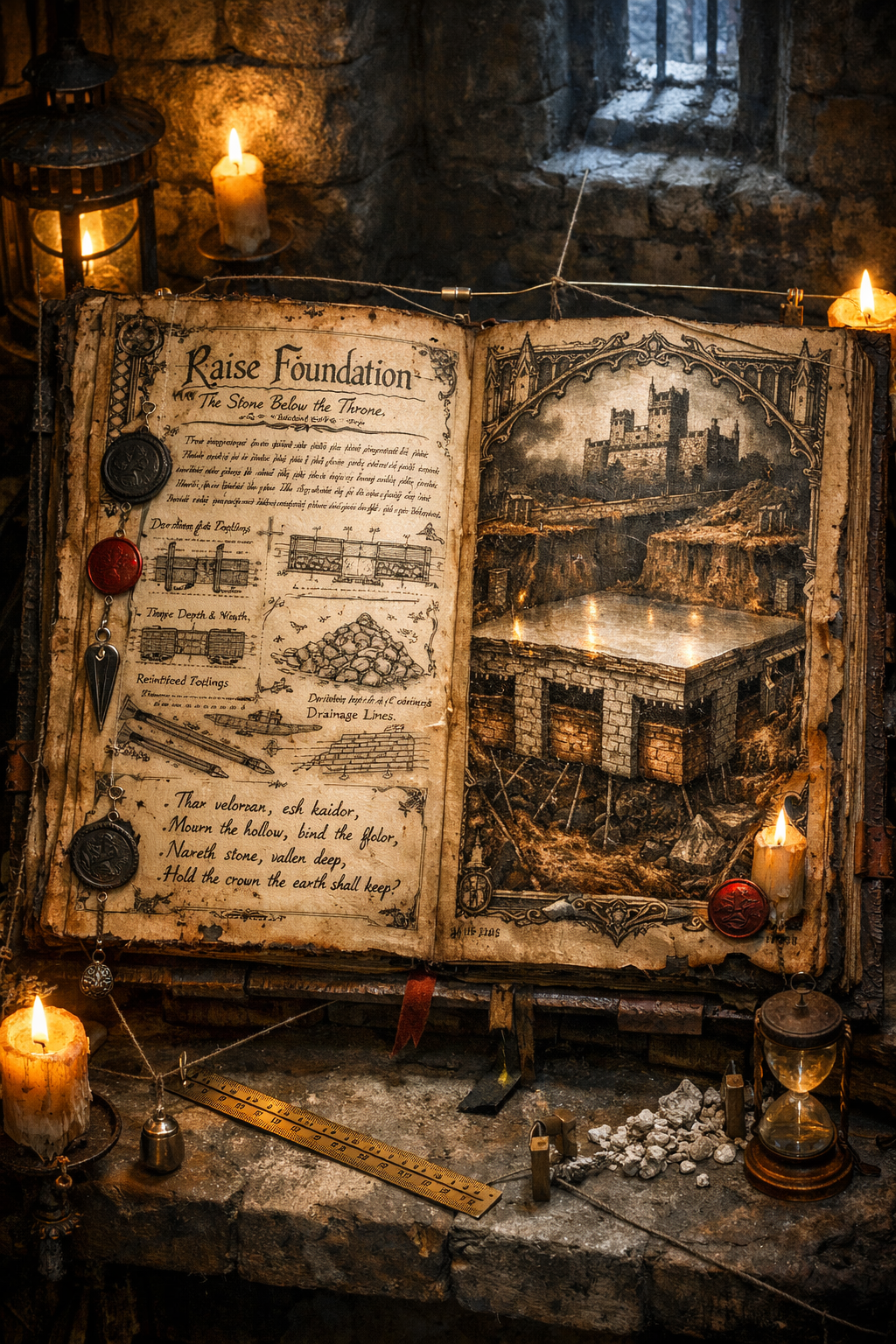
How to Perform the Spell
Setting
This spell must be performed on the chosen footprint of the future fortress at first light or beneath a cold iron dusk. The ground should be marked in full with chalk lines, stakes, cord, and carved survey tablets. The place must feel raw, open, and unresolved. Mud, cut earth, gravel, timber forms, and stacked stone are all fitting signs that the land is ready to be addressed in its sternest language.
Symbolic Tools
The ritual makes use of a trench spade, a mason’s string, a plumb weight, a brass measuring rod, a black ledger of depths, a box of iron pins, a bowl of white gravel, a vessel of gray mortar dust, and four foundation stones set aside as witness markers. For ornament, the master may wear a dark work robe lined in dust colored thread and gloves marked with chalk.
Conditions
The ground must be stripped of false softness. No standing water may remain inside the marked lines. The chosen area must be measured twice and spoken over once. Drainage paths must be acknowledged before the first symbolic footing line is cast. No watcher may step inside the marked footprint after the first invocation unless called by the master builder.
Sequence of Actions
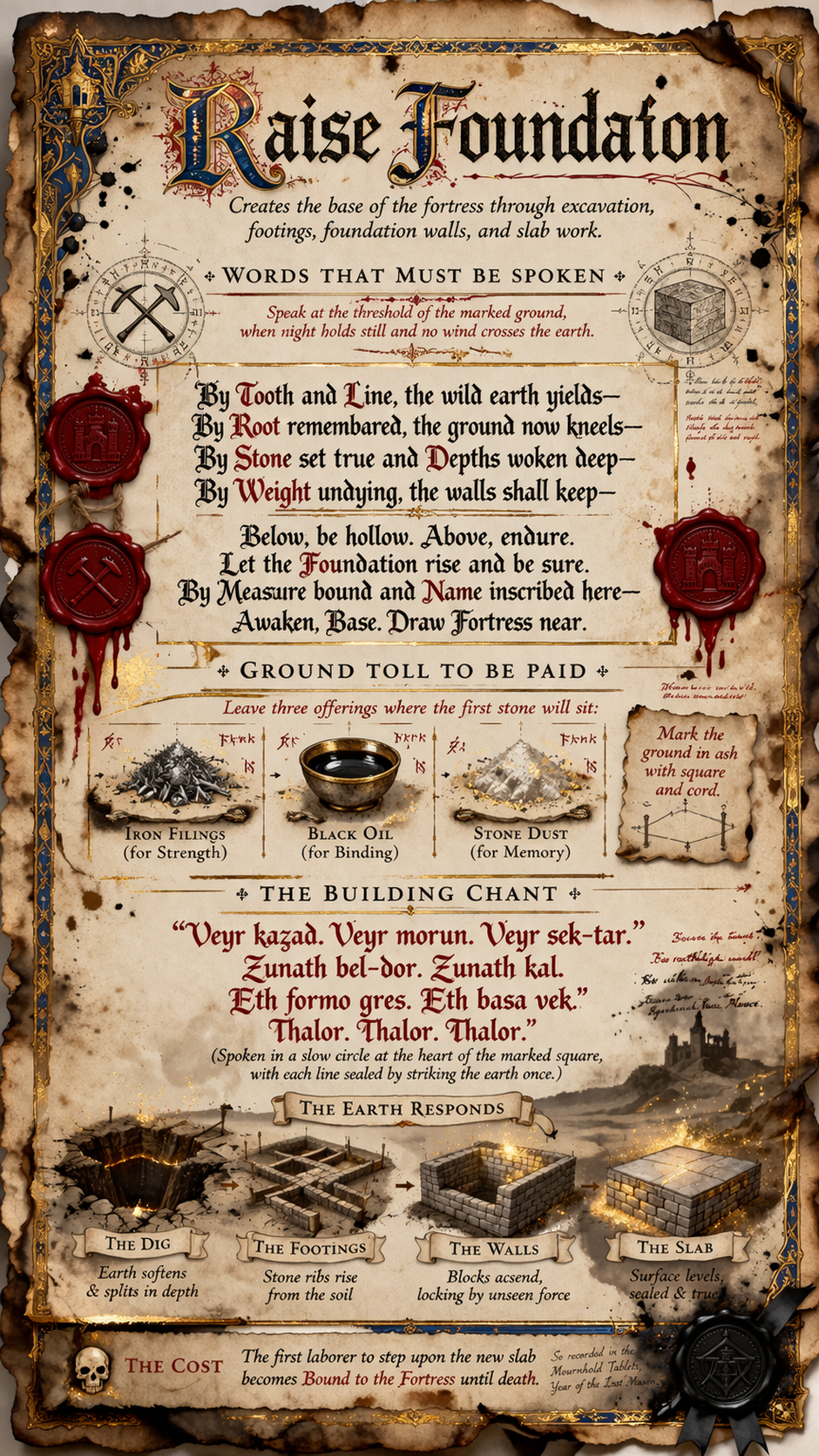
Begin by walking the full perimeter of the future fortress in silence, trailing the brass rod along the marked boundary as if waking the buried outline of the keep. At each corner, drive an iron pin into the earth and place a small scatter of white gravel around it, naming the corner according to its destiny: Gate, Hall, Tower, or Hearth.
Next, open the trench. In storytelling terms, this is done with measured cuts along the wall lines, always straight, always deliberate, as though you are carving channels into the memory of the land itself. Each trench is then inspected by lantern light even if the sun is high, because the old craft says truth in the ground reveals itself best to a patient eye. Loose earth is removed. The trench bottom is leveled. The subgrade is pressed firm beneath the flat of the spade.
When the trench is true, pour a narrow line of mortar dust down its center and lower the first witness stones at the cardinal points. Stretch mason’s string from stone to stone until the whole footprint hums with tension and order. Speak the invented chant:
“Thar veloran, esh kaidor,
Mourn the hollow, bind the floor.
Nareth stone, valen deep,
Hold the crown the earth shall keep.”
After the chant, set the symbolic footings. In the story world this means laying wide channels of intention beneath every future wall, marked by gravel, measuring rod, and iron pins placed in precise rhythm. Then raise the foundation walls by tracing their height in the air with the plumb weight before placing timber forms and filling the void with the imagined force of gray living stone. Walk the interior chambers and cast handfuls of gravel wherever the slab will lie, signifying drainage, settlement resistance, and the banishment of hidden emptiness. Unfurl a pale sheet across the center to symbolize the moisture veil. Over it, spread the final gray dust in a smooth plane as the future floor is called into rest.
Visible Effect
When the spell takes hold, the trenches seem darker and cleaner than ordinary cuts in soil. The strings hold unnaturally straight without trembling. The air grows still. Dust settles flat. The outline of walls becomes perceptible even before they exist, as if the fortress is already deciding where its weight will fall. In the mind’s eye, concrete flashes silver gray, steel lines gleam beneath the surface, and the slab appears for an instant like a moonlit shield laid over the earth.
Cost or Consequence
Raise Foundation demands humility. After performing it, the master builder loses all taste for shallow grandeur. Every future flaw in stone, water path, or settlement line becomes painfully visible to them. Some say this is a gift. Others call it the permanent burden of seeing what lies beneath appearances.
Shop the Spell
A weathered foundation site journal suits this spell beautifully, giving the ritual the feeling of measured depths, wall notes, and trench observations recorded by candlelight.
It is perfect for sketching the unseen bones of the fortress before the first stone is ever imagined above ground.
A brass toned architect ruler set brings elegant precision to the staging of Raise Foundation.
Its severe lines and measured form echo the spell’s obsession with alignment, depth, and proportion.
A dark wax seal kit adds ceremonial gravity to plan scrolls, trench maps, or fictional construction decrees.
It fits the mood of a castle working that values law, permanence, and oath bound geometry.
A cluster of battery powered lanterns helps create the dim inspection atmosphere this spell deserves.
They suggest the lantern light of a builder descending into trench lines to read the truth of the ground.
A stack of aged parchment paper is ideal for drawing foundation plans, drainage paths, and chamber outlines in a way that feels archival and arcane.
The texture instantly deepens the sense that this working belongs to an ancient castle order.
A sturdy wooden book stand gives your grimoire, sketches, or site diagrams a commanding place during the performance.
It turns planning documents into objects of ritual authority instead of ordinary notes.
A tabletop hourglass timer captures the severe patience of this spell.
Raise Foundation is all about depth, cure, waiting, and order, and an hourglass symbolizes each stage with elegant restraint.
A set of old iron key props works as a symbolic reminder that the way into the castle begins below ground.
They feel like relics from chambers that cannot exist until the base of the fortress has first been earned.
Style It With
A bundle of LED pillar candles creates the cold ceremonial glow this spell page deserves without overwhelming the desk or workshop scene.
They suggest a midnight drafting chamber where walls are born first in ink and intention.
A set of stone texture table runners can transform an ordinary writing surface into something that feels closer to a mason’s table in a fortress crypt.
It is an easy way to create a grounded, architectural atmosphere.
A decorative mini castle statue provides a striking visual reminder of what the invisible labor below ground is working toward.
Placed beside the journal, it makes the entire ritual feel more prophetic and complete.
A set of rune style stamps is perfect for embellishing fictional site plans, chamber names, and ceremonial labels around the spell.
They add the impression of old guild marks and builder sigils without leaning on any real esoteric system.
A dramatic hooded black robe costume brings the proper silhouette to a foundation rite rooted in dust, law, and shadow.
It keeps the mood theatrical, ancient, and fully within the language of dark fantasy staging.
A rustic desk magnifier with stand gives your setup the feeling of forensic attention to maps, trench lines, and wall sections.
That severe attention to detail is exactly the spirit of Raise Foundation.