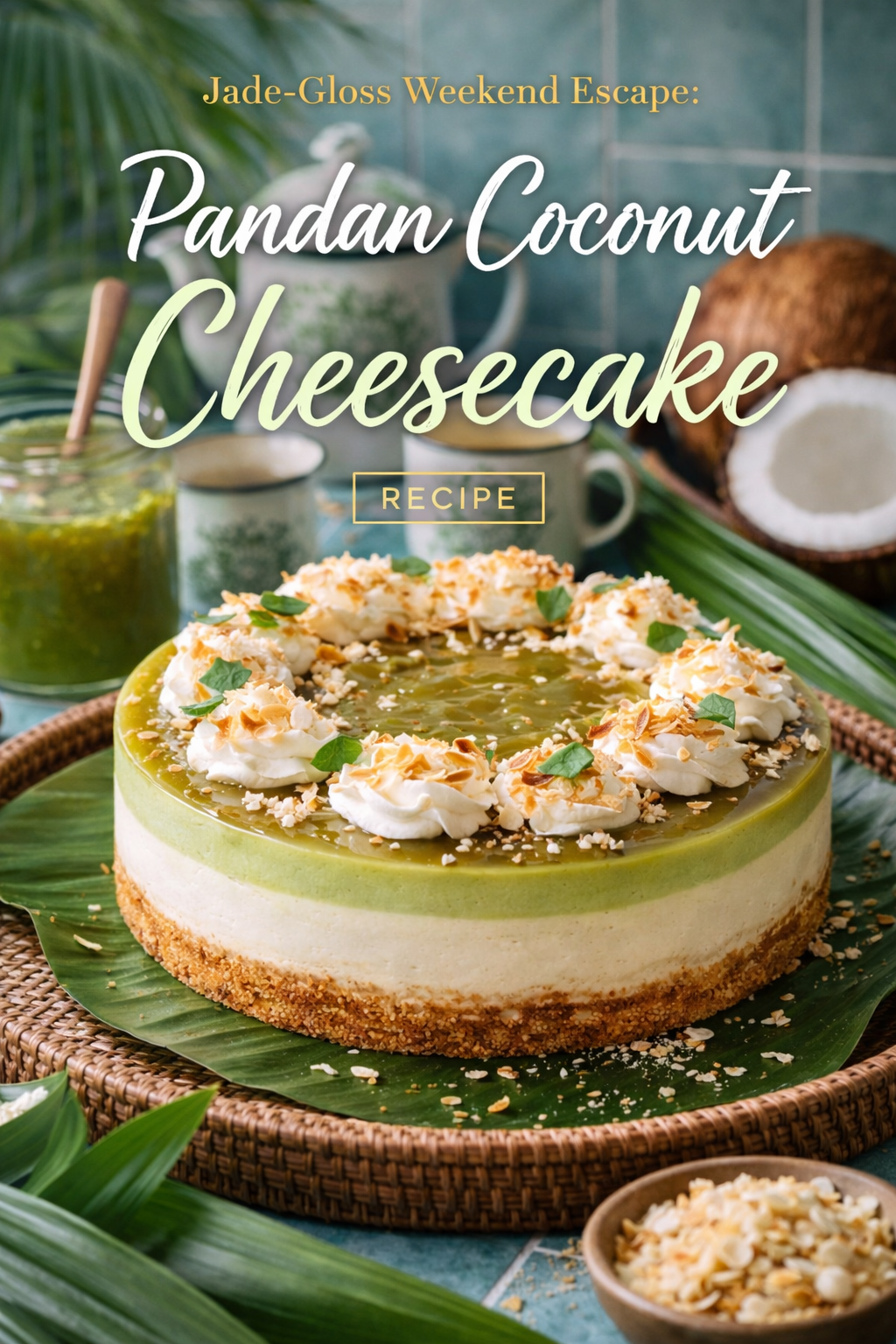
Jade-Gloss Weekend Escape: Pandan Coconut Cheesecake Recipe
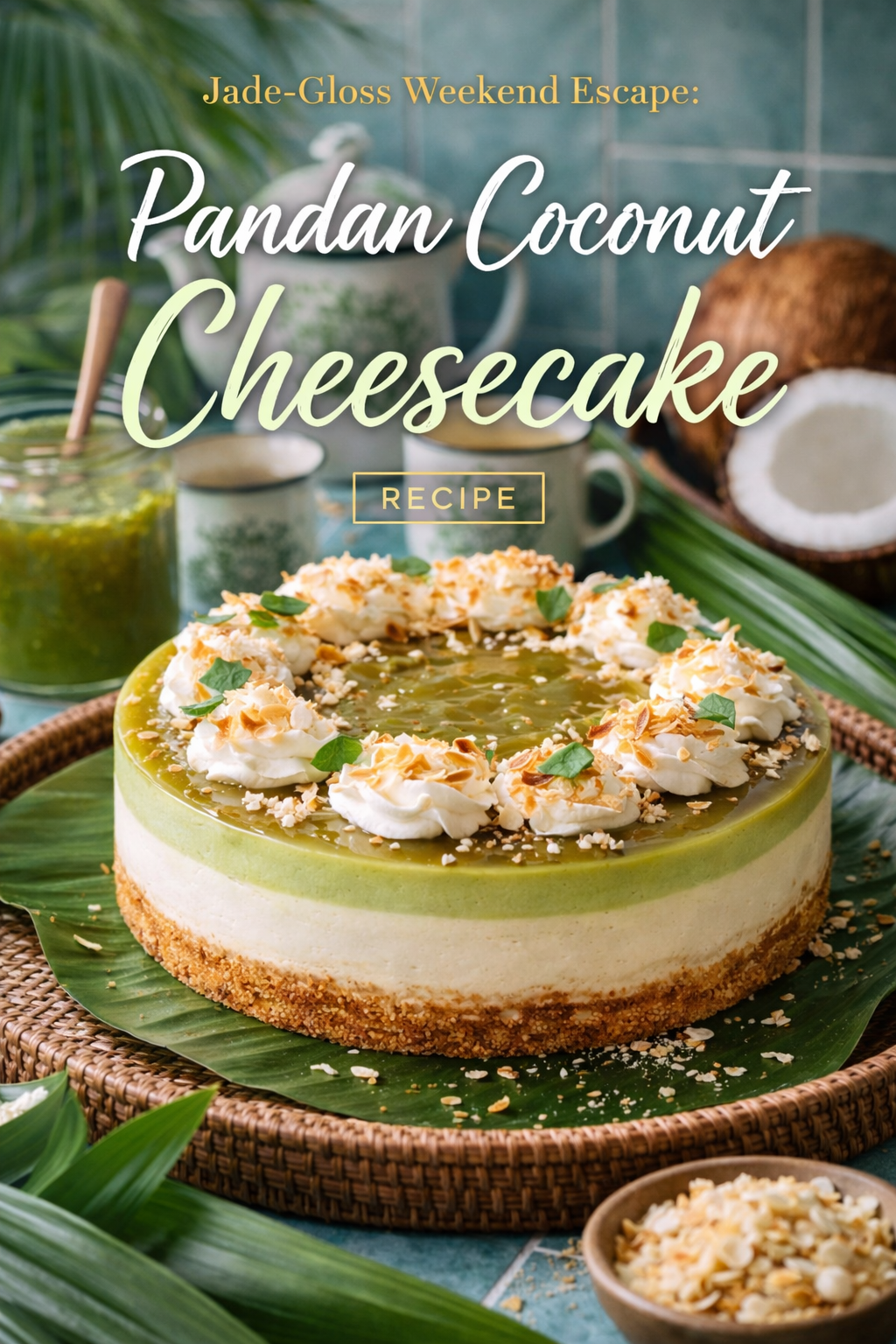
The first thing you notice is the color—an unmistakable jade sheen that looks like it was poured straight from a tropical garden into a glassy, sunlit pool. It sits perfectly level, catching the light in a way that feels calm and decadent at the same time, as if dessert could double as décor. Around the edge, whipped cream rosettes hold their shape like soft, cloud-bright shells, dusted with toasted coconut that turns the whole scene warm and beachy—gold against green, crisp against creamy. Tiny flecks of herb-bright garnish read like a wink of freshness, the kind of detail that makes everything feel intentionally styled rather than simply served.
The setting completes the illusion: broad leaves framing the cheesecake like a centerpiece on a veranda table, woven rattan underneath, and a tiled backdrop that looks cool to the touch. Even the props feel like part of the flavor—an old-world teapot and cups, a jar of vivid green sauce with a spoon still resting inside, a halved coconut waiting patiently nearby. It’s the kind of tableau that suggests slow time: afternoon light, a fan turning lazily, the air smelling faintly of toasted coconut and something floral you can’t quite name until your brain lands on pandan—vanilla’s more intriguing cousin, grassy-sweet and softly nutty, with a perfume that belongs to warm climates and open windows.
This Pandan Coconut Cheesecake doesn’t shout. It glows. It leans into contrast in a way that feels quietly luxurious: a sandy, toasted crust that snaps just enough to announce itself; a pale, creamy middle that reads like coconut milk made into silk; and that top layer—pandan-forward, glossy, and lush—like a satin ribbon laid across the surface. The coconut doesn’t just appear as a garnish; it echoes through the whole experience. Toasted flakes give you that browned-sugar aroma, and the cream swirls deliver the soft, airy lift that balances the dense richness of cheesecake so every bite finishes clean instead of heavy.
The magic of this flavor pairing is that it feels familiar and new at once. Coconut is comfort—sun, sweetness, and that mellow roundness that makes desserts taste like celebration. Pandan is the twist: elegant, aromatic, green in a way that’s both visual and sensory. Together, they create a dessert that tastes like a vacation you didn’t plan but absolutely needed. When the slice hits the plate, you get those neat layers—crust, ivory, pale green, glossy jade—like a little architecture of calm. It’s the kind of dessert that makes people pause mid-conversation, not because it’s loud, but because it’s beautiful in a way that seems almost unreal.
There’s also something satisfying about how intentional the textures feel. A good cheesecake is never just “creamy”—it’s dense but delicate, rich but not cloying, and it should slice like a dream. That’s where the right tools quietly matter. A clean release from the pan keeps those layers crisp and photogenic, especially if you’re using a reliable springform pan that releases smoothly. And if you’ve ever tried to coax silky batter out of a mixing bowl with a flimsy spatula, you already know why a flexible silicone spatula set can feel like the difference between “good enough” and “professional.”
The pandan piece is where the mood shifts from classic to captivating. Some people prefer a subtle whisper; others want the full aromatic bloom. Either way, it helps to start with a high-quality pandan source—whether that’s extract, paste, or essence—because the wrong one can taste artificial instead of lush. If you’re shopping, look for pandan extract or pandan paste options that have strong reviews and a clean ingredient list. Coconut, too, has its own spectrum: sweetened flakes, unsweetened shreds, fine desiccated, or big dramatic chips. For the toasted finish that looks like sunlight on whipped cream, unsweetened coconut flakes for toasting give you the most control over sweetness and color.
This is the kind of dessert that invites ritual. You can almost hear the soft tap of a knife against the crust, the whisper of a slice lifting cleanly, the small silence that happens when someone takes the first bite. It pairs naturally with tea—something floral, jasmine, or even a gentle green tea—served in a cup that feels special even if it’s an everyday one. The tropical notes make it equally at home beside coffee, especially if you like the contrast of bitterness and sweetness. The whipped cream rosettes are not just decoration; they act like little pauses between bites, airy relief that lets the pandan and coconut keep their clarity instead of blending into a single rich note.
If you’re the kind of cook who likes the process as much as the result, cheesecake delivers. It’s unhurried by nature. Ingredients soften on the counter. Batter gets mixed slowly, carefully, so it stays satiny. The oven hums quietly. Cooling takes patience. Chill time turns anticipation into a reward. Even the topping feels like a final flourish, a glossy layer that transforms a simple cake into something that looks plated at a resort café. For that finish, a fine-mesh strainer helps keep custards and glazes smooth, and a dependable digital kitchen scale makes the crust-to-filling ratio feel effortlessly consistent.
And then there’s the toasted coconut—tiny, golden, fragrant confetti. Toasting it is a small moment that changes everything: the aroma deepens, the flavor turns nutty and caramel-leaning, and the texture becomes crisp enough to crackle against whipped cream. It’s the kind of detail you notice even if you don’t consciously name it. It signals care. It signals craft. It signals that this isn’t just dessert—it’s a mood you can slice.
Pandan Coconut Cheesecake belongs to that category of recipes that feel like an atmosphere. Tropical without being loud. Elegant without being fussy. A dessert that looks like a jewel and tastes like a slow afternoon—cool tiles under your feet, green leaves in the corners of your vision, and a soft sweetness in the air that makes you linger long after the plate is empty.
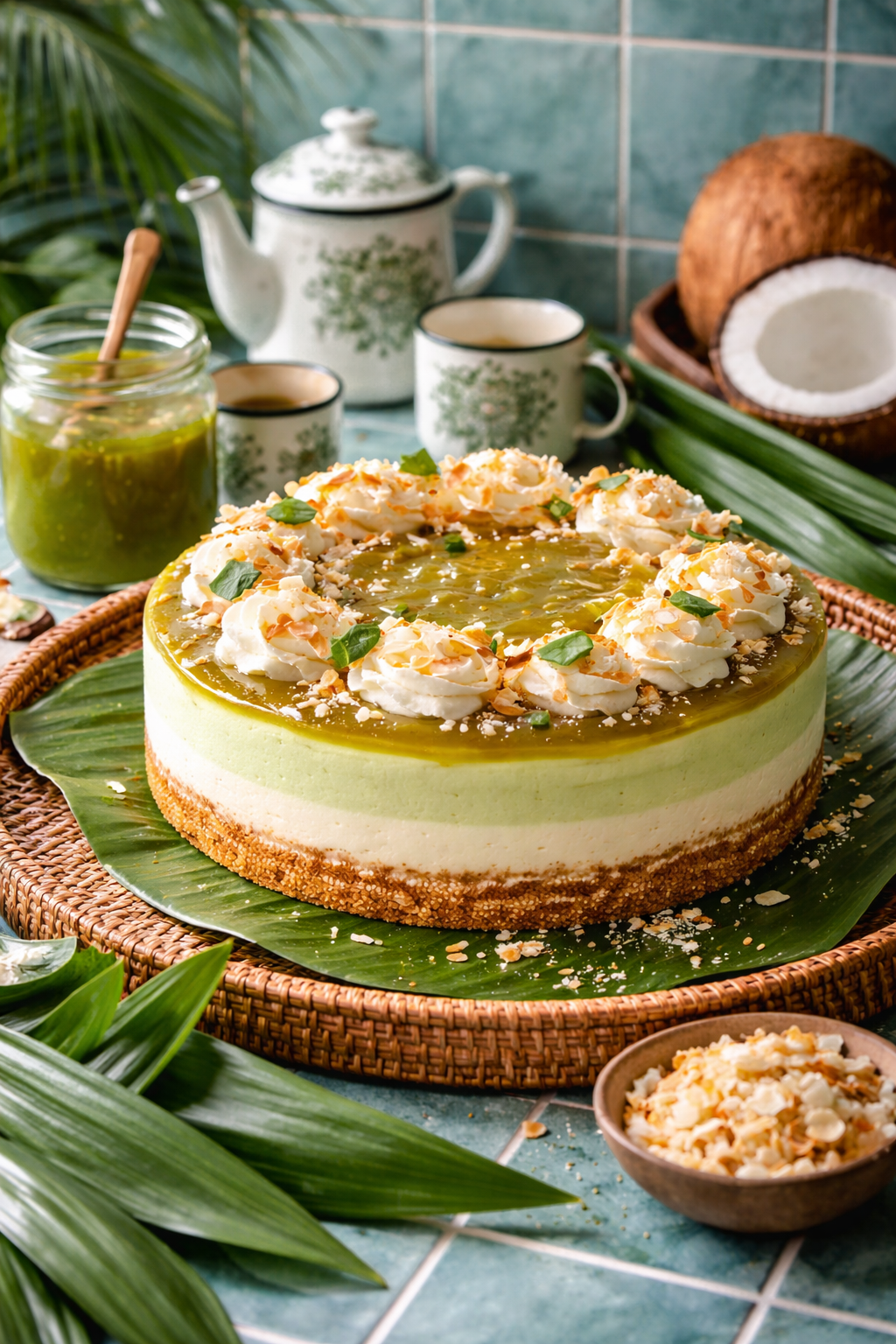
Pandan Coconut Cheesecake is a layered, tropical-leaning dessert with a crisp crust, a creamy coconut cheesecake center, and a glossy pandan topping finished with toasted coconut and whipped cream.
Ingredients
Crust
- 2 cups graham cracker crumbs (or digestive biscuit crumbs)
- 1/3 cup granulated sugar
- 1/2 cup unsalted butter, melted
- Pinch of salt
Coconut Cheesecake Filling
- 24 oz (3 blocks) cream cheese, room temperature
- 3/4 cup granulated sugar
- 1/4 cup sour cream
- 1/2 cup coconut cream (or full-fat coconut milk)
- 3 large eggs, room temperature
- 1 tbsp vanilla extract
- 1/4 tsp salt
- 1 tbsp cornstarch (optional, for extra stability)
Pandan Topping (Gloss Layer)
- 1 cup coconut milk
- 1/3 cup sugar
- 2 tsp pandan extract (adjust to taste)
- 2 tbsp cornstarch
- Pinch of salt
Finish
- Whipped cream (homemade or store-bought)
- Toasted coconut flakes
Method / Instructions
- Prep the pan: Grease a 9-inch springform pan and line the bottom with parchment. Wrap the outside with foil if using a water bath.
- Make the crust: Mix crumbs, sugar, salt, and melted butter. Press firmly into the pan base. Bake at 350°F for 10 minutes, then cool.
- Mix filling: Beat cream cheese and sugar until smooth. Mix in sour cream and coconut cream, then vanilla and salt. Add eggs one at a time on low, mixing just until combined. (Fold in cornstarch if using.)
- Bake: Pour over crust. Bake at 325°F in a water bath (or with a pan of hot water on the lower rack) until edges are set and center still slightly wobbly, about 55–70 minutes.
- Cool + chill: Cool in the turned-off oven with the door cracked 45–60 minutes, then cool to room temp. Chill at least 6 hours, ideally overnight.
- Pandan topping: Heat coconut milk and sugar. Whisk cornstarch with a few tablespoons of cold coconut milk, then whisk into the pot. Cook until glossy and thickened. Remove from heat, stir in pandan extract and salt. Cool 10 minutes.
- Top + finish: Pour topping onto chilled cheesecake and spread evenly. Chill 1–2 hours to set. Garnish with whipped cream rosettes and toasted coconut.
A cheesecake this polished is all about calm precision. The goal is a filling that’s creamy and smooth—never airy—plus a topping that sets with a clean gloss. Here’s how to get that resort-level slice, step by step, with the “why” behind each move.
Start by building the foundation. Crush your crackers or biscuits until they’re uniform—think sand, not pebbles. Uneven crumbs create weak spots that crumble when you slice. A food processor for fine, even crumbs makes this fast, but a zip-top bag and rolling pin works too—just take your time. Once the crumbs are ready, mix them thoroughly with sugar and melted butter. You’re looking for a texture like wet beach sand: it should clump when squeezed. Press the crust down firmly and evenly, especially around the edges, using the base of a glass or a flat measuring cup. This compaction is what gives you a crust that slices cleanly instead of shedding.
Pre-baking the crust matters because it sets the structure and deepens flavor. Ten minutes at 350°F is usually enough. When it comes out, let it cool while you prepare the filling. That pause is not dead time—it prevents the crust from steaming under warm batter, which can soften it.
Now focus on temperature. Room-temperature cream cheese is non-negotiable if you want a silky batter. Cold cream cheese forces you to mix harder, which adds air. Air expands in the oven, then collapses into cracks. Set your blocks out for at least an hour. If you’re serious about consistent results, a digital instant-read thermometer can confirm your ingredients aren’t fridge-cold—handy when kitchen conditions vary.
Mixing is about smoothness without fluff. Beat the cream cheese and sugar just until the mixture is glossy and lump-free. Scrape the bowl often—especially the bottom where dense cream cheese hides. A sturdy stand mixer or hand mixer helps, but your restraint matters more than horsepower. Add sour cream and coconut cream next. Coconut cream brings richness and a subtle tropical depth; full-fat coconut milk works, but coconut cream gives the most luxurious body. If you’re selecting ingredients, look for coconut cream or full-fat coconut milk with minimal additives for the cleanest flavor.
Eggs come last, one at a time, on low speed. This is where many cheesecakes go wrong: overmixing the eggs whips in air, leading to puffing and cracking. Mix each egg only until it disappears. If you’re adding cornstarch for stability, incorporate it gently—its job is to help the cake slice neatly and resist weeping, especially with a topping layer.
Baking technique is where the texture is won. A water bath is your best insurance policy: it moderates oven heat and prevents the edges from overcooking while the center sets. Wrap the outside of the springform pan with heavy-duty foil, set it in a larger roasting pan, and pour hot water halfway up the sides. A reliable roasting pan for water baths makes this easier, but any deep pan works. If you avoid water baths, at least place a pan of hot water on a lower rack to add humidity.
Bake at 325°F, and don’t chase a perfectly firm center. The edges should look set and slightly puffed; the center should still have a gentle wobble, like thick custard. If you wait until it’s fully firm, it will be overbaked by the time it cools—and overbaked cheesecake tastes dry and slightly grainy. Ovens vary, so use visual cues over strict time. This is also a moment where an oven thermometer quietly saves you; many ovens run hot or swing temperatures, and cheesecake is sensitive to both.
Cooling is a continuation of baking. Turn the oven off, crack the door, and let the cheesecake sit for 45–60 minutes. This gradual drop in temperature reduces contraction shock, which is a major cause of cracks. After that, move it to a counter and cool to room temperature before chilling. If you rush it into the fridge while still warm, condensation forms and can make the surface tacky—bad news if you want a pristine topping layer.
Chill time is where the texture transforms from soft to sliceable. Six hours is the minimum; overnight is ideal. During the chill, the fats firm and the structure settles, giving you that dense, creamy bite that feels luxurious instead of mousse-like.
Now for the pandan gloss layer—the signature finish. You want it thick enough to sit beautifully without soaking in, and smooth enough to look like lacquer. Start by warming coconut milk and sugar until steaming and fully dissolved. Separately, whisk cornstarch with a little cold coconut milk to make a slurry—this prevents lumps. Pour the slurry into the warm liquid while whisking constantly and keep cooking until it thickens and turns glossy. A silicone whisk is great here because it reaches corners without scratching cookware.
Add pandan extract off the heat. Pandan can be delicate; cooking it too aggressively can mute its aroma. Start modest, taste, then adjust. The goal is a soft, fragrant green—not candy-bright. If you’re shopping for flavoring, choose pandan extract that’s well-reviewed for authentic aroma. Let the topping cool for about ten minutes before pouring. Too hot, and it can soften the cheesecake surface; too cool, and it can set before you spread it.
Pour the pandan topping onto the fully chilled cheesecake and nudge it to the edges with an offset spatula. Then return it to the fridge to set—usually 1–2 hours. This creates that clean, sliceable top layer that stays glossy and doesn’t smear.
Toasted coconut is the finishing move that makes everything feel intentional. Spread coconut flakes on a baking sheet and toast at 325°F, stirring once or twice, until golden. Watch closely; it goes from pale to dark quickly. Unsweetened flakes toast more evenly and give you better control—look for unsweetened coconut flakes if you want that warm, nutty crunch without extra sugar.
For whipped cream rosettes, keep it stable. If you’re piping, chill your bowl and beaters first and use heavy cream that’s very cold. A piping bag with a star tip gives you those neat swirls; a piping bag and tip set makes it simple. If you prefer a no-fuss approach, dollop and swoosh with a spoon—still beautiful, just more casual.
Troubleshooting is mostly prevention. If your cheesecake cracks, it’s usually from overmixing, overbaking, or cooling too quickly. The good news: the pandan topping and whipped cream garnish cover imperfections effortlessly. If your topping looks dull, it likely wasn’t cooked long enough to fully gelatinize the starch; rewarm gently and whisk until glossy, then cool slightly and reapply. If your crust is too soft, it needs more compaction or a longer pre-bake, and making sure the cheesecake cools fully before chilling helps prevent steam from softening it.
Variations are easy without losing the soul of the dessert. Want more coconut presence? Replace part of the sour cream with coconut yogurt. Want brighter tang? Add a teaspoon of lime zest to the filling. Want extra crunch? Sprinkle toasted coconut between the cheesecake layer and the pandan topping for a hidden texture moment—just keep it light so the topping still adheres.
Finally, slicing is presentation. Use a long knife, warm it in hot water, wipe dry, then slice in confident strokes, cleaning the blade between cuts. This preserves the layers and keeps the pandan top pristine. Serve it cold, when the cheesecake holds its shape and the flavors are most defined—the coconut mellow and creamy, the pandan aromatic and green, and the toasted flakes finishing each bite like a warm breeze.